Dental Crowns: The Complete Guide to Types, Costs, and Long-Term Care
Introduction:
Your Complete Roadmap to Dental Crowns A damaged tooth does not have to mean the end of your smile. Dental crowns restore broken, weakened, or heavily filled teeth to full function and natural appearance. This guide covers every decision you will face:
which material suits your tooth, what the procedure involves, how much you will pay, and how to protect your investment for years. Whether you need a single crown or are comparing restorative options, you will find clear answers here.
What Are Dental Crowns and When Do You Need One?
A dental crown is a custom-made cap that covers the visible portion of a damaged tooth above the gumline. Dentists bond it permanently in place to restore shape, strength, and appearance.
You may need a crown when:
- A large filling has weakened the remaining tooth structure
- A tooth has cracked or fractured
- You have completed root canal treatment and need protection
- A tooth is severely worn down from grinding
- You want to cover a discoloured or misshapen tooth
- You need to cap a dental implant
Crowns preserve natural teeth whenever possible. Removing a tooth should always be the last resort.
Dental Crown Materials Compared: Which Type Lasts Longest?
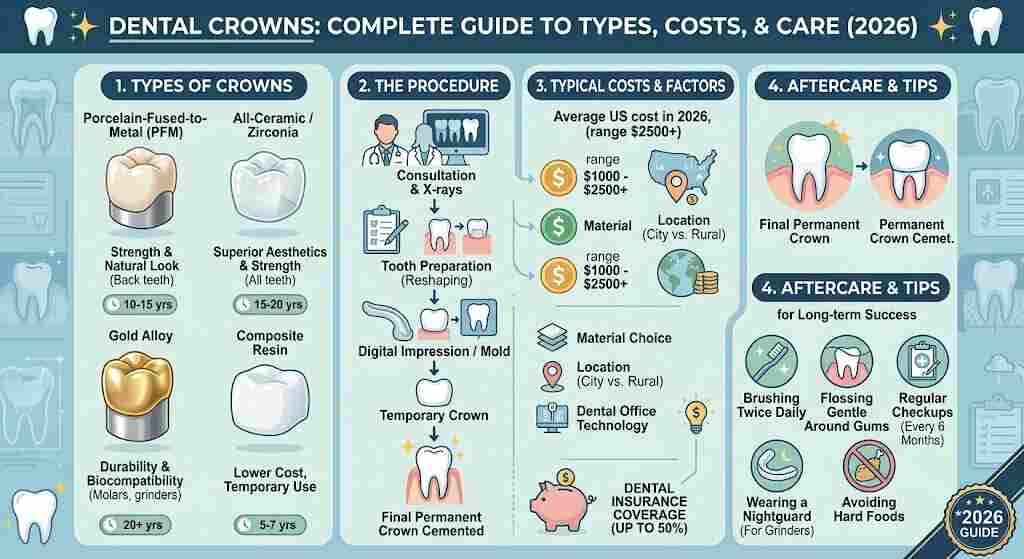
Material choice drives both cost and longevity. The most popular choices for 2026 are contrasted in the table below.
| Crown Material | Typical Cost (USD) | Expected Lifespan | Best For | Aesthetic Quality |
|—|—|—|—|—|—|
| Porcelain-Fused-to-Metal (PFM) | $800–$2,000 | 10–15 years | Back teeth, budget-friendly | Good |
| All-Ceramic / Zirconia | $1,000–$2,500 | 15–20 years | Front and back teeth | Excellent |
| Gold Alloy | $900–$3,000 | 20+ years | Molars, heavy grinders | Poor |
| Composite Resin | $400–$800 | 5–7 years | Temporary or low-load teeth | Moderate |
| Same-Day CEREC Ceramic | $1,000–$2,500 | 10–15 years | Single-visit convenience | Excellent |
Source: Real Dental Costs 2026 benchmarks
Monolithic zirconia crowns demonstrate 97.4% survival at five years and 94.2% at ten years. Lithium-disilicate (e-max) crowns achieve 98.5% five-year survival, making them the top performer in recent systematic reviews.
Key takeaway: Zirconia and lithium disilicate offer the best balance of strength and appearance for most patients.
How Long Do Dental Crowns Last?
A well-cared-for crown lasts 10 to 15 years on average. Many patients exceed this range with excellent hygiene and regular dental visits.
Factors that shorten crown lifespan:
- Teeth grinding (bruxism) without a nightguard
- Chewing ice, hard candies, or sticky foods
- Poor oral hygiene leading to decay at the crown margin
- Skipping routine dental check-ups
Factors that extend crown lifespan:
- Wearing a custom nightguard if you grind
- Brushing twice daily with fluoride toothpaste
- Flossing gently around the crown daily
- Avoiding using teeth as tools
Systematic reviews confirm that modern ceramic crowns rival metal-ceramic crowns in five-year survival, with monolithic designs reducing fracture risk significantly.
The Dental Crown Procedure: Step-by-Step
Most dental crowns require two appointments spaced two to four weeks apart.
First Appointment:
- Examination and X-rays — Your dentist assesses the tooth and surrounding bone.
- Anaesthesia — Local anaesthetic ensures comfort throughout.
- Tooth preparation — The dentist files down the tooth to make room for the crown.
- Impression or digital scan — A mould or digital scan captures your bite.
- Temporary crown placement — A protective temporary crown covers the prepared tooth.
Second Appointment:
- Temporary crown removal
- Fit and colour check — Your dentist verifies the crown matches your bite and appearance.
- Permanent cementation — The crown bonds securely in place.
Same-Day Crowns: CAD/CAM technology lets some practices design, mill, and place a ceramic crown in a single visit.
Are Dental Crowns Painful?
You will receive local anaesthesia during tooth preparation, so the procedure itself is comfortable. Mild sensitivity after the appointment is normal and usually fades within a few days.
When to call your dentist:
- Bite feels uneven after several days
- Persistent pain or throbbing
- Crown feels loose
- Sharp sensitivity to hot or cold that does not improve
These symptoms rarely indicate serious problems, but early attention prevents complications.
Dental Crowns vs. Veneers vs. Implants: What’s the Difference?
These three restorations serve different purposes.
| Feature | Dental Crown | Veneer | Implant |
| Coverage | Entire tooth | Front surface only | Replaces entire tooth including root |
| Best For | Damaged, weakened teeth | Cosmetic front-tooth improvements | Missing teeth |
| Longevity | 10–15 years | 10–15 years | 20+ years |
| Tooth Structure | Requires filing down | Minimal preparation | Requires extraction of damaged tooth |
Choose a dental crown when the tooth is damaged but salvageable. Choose a veneer for cosmetic enhancement of healthy teeth. Choose an implant when the tooth is missing or beyond repair.
How Much Do Dental Crowns Cost in 2026?
A single dental crown averages $1,369 per tooth in the United States in 2026. State averages range from $1,046 in Alabama to $2,331 in California.
Cost factors:
- Material type — The single biggest driver of price
- Geographic location — Urban practices charge more
- Tooth position — Front teeth require more aesthetic precision
- Additional procedures — Root canal or core build-up adds cost
UK costs: NHS crowns fall under Band 3 treatment at £332.10 (2026). Private crowns typically cost £500 to £1,200+ per tooth.
Does Dental Insurance Cover Crowns?
Most full-coverage dental plans pay up to 50% of the cost for major restorative care, including dental crowns. You typically pay $500–$900 out of pocket with insurance.
Coverage essentials:
- Crowns usually fall under major restorative benefits, not preventive care
- Many plans require a waiting period for major services
- Annual maximums often limit total coverage
- Pre-authorisation may be required before treatment
Always confirm your specific benefits with your insurance carrier before scheduling treatment.
Essential Aftercare: How to Make Your Crown Last
Proper care determines whether your crown lasts five years or twenty.
Daily habits:
- Brush twice daily with a soft-bristled toothbrush and fluoride toothpaste
- Floss gently around the crown margin to remove plaque
- Use an interdental brush if recommended by your dentist
Lifestyle adjustments:
- Avoid chewing ice, hard candies, and sticky foods
- Do not open packages or bottles with your teeth
- Wear a nightguard if you grind your teeth
Professional care:
- Schedule dental check-ups every six months
- Get professional cleanings to maintain gum health
- Report any looseness, discomfort, or changes immediately
Patients who follow these steps protect both the crown and the underlying tooth.
Common Problems and Complications with Dental Crowns
Crowns are highly successful, but problems can occur.
Early complications (first 24 months):
- Debonding — The crown loosens or falls off
- Fracture — Catastrophic breakage from occlusal forces or material defects
- Aesthetic dissatisfaction — Colour or shape does not meet expectations
Late complications:
- Decay at the margin — Bacteria accumulate where crown meets tooth
- Gum recession — Exposes the crown edge
- Wear — The opposing tooth or crown wears down over time
The Australian Dental Association reports that most crown complaints relate to early failure or cosmetic concerns. Choosing an experienced dentist and following aftercare instructions dramatically reduces these risks.
How to Choose the Right Dentist for Your Crown
Your dentist’s skill matters more than the material you choose.
What to look for:
- Experience — Ask how many crowns they place monthly
- Technology — Digital scanning improves fit accuracy
- Communication — They explain material options clearly
- Reviews — Look for patient feedback on restorative work
- Credentials — Membership in professional dental associations
A well-prepared tooth and precisely fitted crown form the foundation of long-term success.
Frequently Asked Questions About Dental Crowns
What is the duration of a dental crown procedure?
Most dental crowns require two appointments over two to four weeks. Same-day crowns using CAD/CAM technology are available at some practices and can be completed in a single visit.
Can I eat normally with a dental crown?
Indeed. You can resume regular eating when the permanent crown is fixed. For the first few days, stay away from really sticky or hard meals to allow the cement to cure completely.
Will a dental crown look natural?
Modern ceramic and zirconia crowns closely match natural tooth colour and translucency. The crown will be shade-matched to the teeth around it by your dentist.
Do dental crowns require special cleaning?
No special products are needed.As usual, brush and floss, being very mindful of the gum line surrounding the crown.
What happens if my dental crown falls off?
Clean the crown, keep it safe, and call your dentist immediately. Never attempt to repair it with common household glue. If necessary, your dentist can build a new one or recement it.
Are dental crowns better than fillings?
When a tooth is too damaged for a filling, crowns are required. For small to moderate cavities, fillings remain the simpler and more conservative choice.
Conclusion: Take Control of Your Dental Health Today
Dental crowns protect damaged teeth, restore confident smiles, and deliver decades of reliable function. You now understand the materials, the procedure, the costs, and the aftercare that makes all the difference. Your next step is simple: schedule a consultation with a qualified dentist. Ask questions. Compare options. Make an informed choice. Your smile deserves nothing less.