How Long Does a Toradol Shot Last? The Complete Timeline
You wake up in pain. The ER nurse hands you a shot and says it will help. Then you wonder when the relief ends and what to do next. This guide answers how long does a Toradol shot last, how to time your next dose of pain relief safely, and which warning signs need a call to your doctor.
What Is a Toradol Shot?
Ketorolac tromethamine is marketed under the name Toradol. . It belongs to the nonsteroidal anti-inflammatory drug (NSAID) family, the same family as ibuprofen and naproxen. Doctors use the injection for moderate to severe pain that lasts a short time.
Clinics, urgent care centers, and emergency rooms give it for kidney stones, migraine, post-surgical pain, back strain, and injuries Prostaglandins, the molecules that cause pain and swelling, are blocked by it. It is not an opioid, and it does not put you to sleep.
| Fact | Detail |
| Generic name | Ketorolac tromethamine |
| Brand name | Toradol |
| Drug class | NSAID |
| Given by | Intramuscular (IM) or intravenous (IV) injection |
| Typical use | Short-term pain relief |
| Not an opioid | Correct. It carries no sedative effect |
How Long Does a Toradol Shot Last?
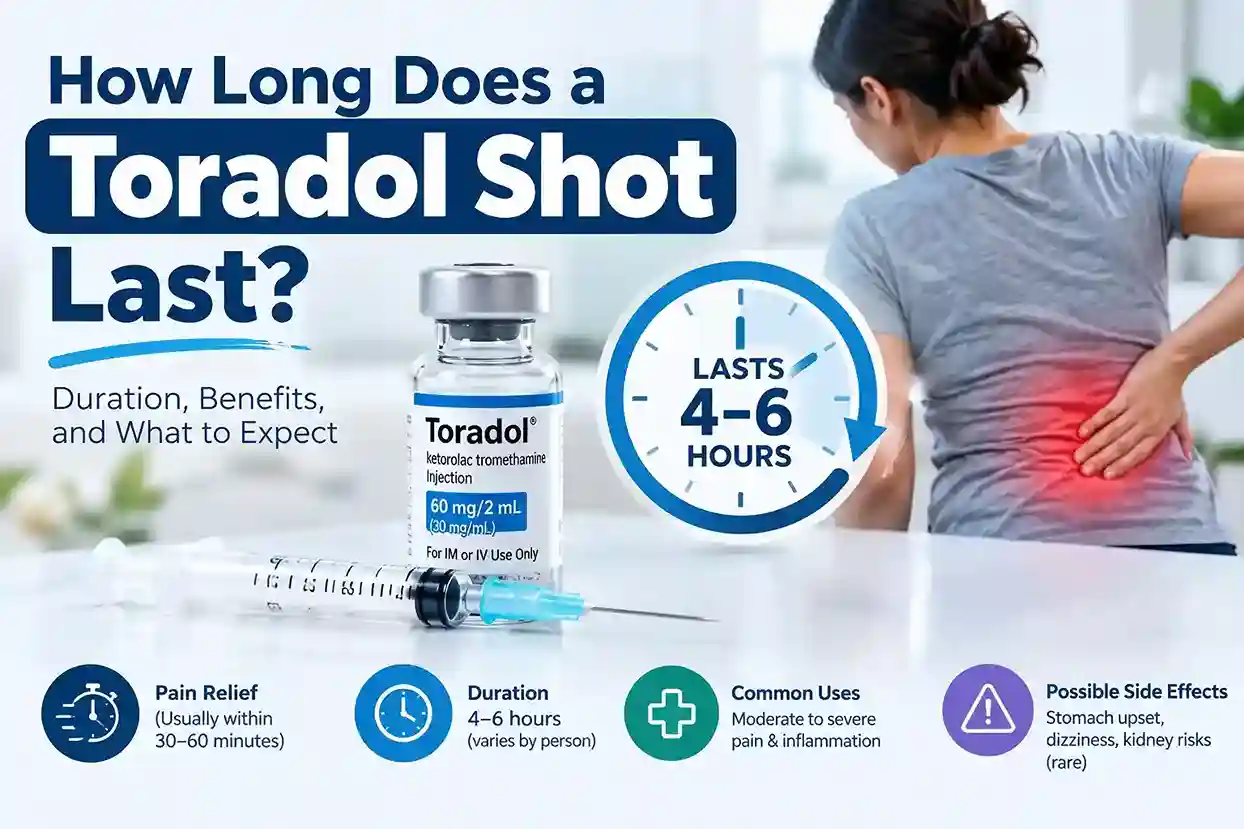
Here is the direct answer to how long does a Toradol shot last in real life. Pain relief begins within 30 to 60 minutes, peaks in the first one to two hours, and fades over the next 4 to 6 hours. Some patients report relief closer to 8 hours.
The label supports this pattern. Doctors typically repeat doses about every 6 hours when a patient needs more. Think of the shot as one working shift, not an all-day fix.
| Stage | Typical timing |
| Onset | 30 to 60 minutes |
| Peak effect | About 1 to 2 hours |
| Main relief window | 4 to 6 hours |
| Upper range for some people | Up to 8 hours |
| Next dose (if prescribed) | Usually about every 6 hours, per your clinician |
Pain can return before the 4-hour mark if the injury is severe or the dose was low. Tell your nurse if relief fades early.
How Much Time Does Toradol Remain in Your Body?
Relief and presence in your body are two different clocks. Relief ends in hours. The drug itself lingers longer.
The average half-life of ketorolac in healthy adults is about 5 to 6 hours. Half-life is the time your body needs to cut the drug level in half. Medical references commonly say a drug is mostly gone after five half-lives, so Toradol clears in roughly 24 to 30 hours for a healthy adult.
| Group | Approximate half-life |
| Healthy young adults | About 5 to 6 hours |
| Adults aged 65 to 78 | About 7 hours |
| Patients with kidney impairment | About 6 to 19 hours, based on severity |
| Patients with liver disease | Similar to healthy adults in the label data |
Your kidneys remove most of the drug. That is why kidney health changes the clearance timeline more than any other factor.
What Changes How Long a Toradol Shot Lasts?
No two people feel the same timeline. Several factors stretch or shorten the effect.
- Age. Older adults clear ketorolac more slowly, so the drug stays longer.
- Kidney function. Weak kidneys raise the half-life sharply and raise the risk of harm.
- Dose. The label notes that bigger doses mainly extend the length of pain relief, not the strength. Higher doses do not add safety.
- Route. IV doses act a little faster than IM doses. Total duration stays similar.
- Pain source. Inflammatory pain responds well. Nerve pain often responds poorly.
- Body weight. Adults under 50 kg receive lower doses.
- Other medicines. Probenecid raises ketorolac levels and extends its stay, so doctors do not combine them.
| Factor | Effect on timeline | Action |
| Age 65+ | Longer stay in the body | Expect a reduced dose |
| Kidney disease | Much longer stay, higher risk | Tell the clinician before the shot |
| IV vs IM | IV starts faster | Ask which route fits your case |
| Low body weight | Reduced dose | Share your weight |
| Probenecid use | Longer stay, unsafe pairing | Report all medicines |
Dosage Limits and the 5-Day Rule
The FDA label limits total ketorolac use to 5 days across all forms: injection, tablets, and nasal spray combined. Longer use raises the chance of stomach bleeding, kidney injury, and heart problems.
The oral form exists only as follow-up after the injection. A prescriber chooses the dose by age, weight, and kidney function. Adults under 65 often receive a single 30 mg IV or 60 mg IM dose. Adults 65 and older, people under 50 kg, and people with kidney problems usually receive half of that. Only your clinician should set your dose.
| Rule | Limit |
| Total treatment length | 5 days maximum, all forms combined |
| Oral tablets | Follow-up to the shot only |
| Dose scale | Lower for age 65+, under 50 kg, or kidney problems |
| Spinal or epidural use | Never |
| Extra doses for stronger pain | Do not self-adjust |
Toradol Shot vs. Tablets and Other Pain Relievers
People often ask whether the shot beats a pill. The shot acts faster and delivers a full dose without stomach absorption. The tablet suits follow-up care.
| Option | Speed | Typical relief | Best for |
| Toradol shot (IM/IV) | 30 to 60 minutes | 4 to 6 hours | Acute pain in a clinic |
| Ketorolac tablet | Slower | Several hours | Short follow-up after the shot |
| Ibuprofen (OTC) | 30 to 60 minutes | 4 to 6 hours | Mild to moderate pain |
| Acetaminophen | 30 to 60 minutes | 4 to 6 hours | Pain and fever, easier on the stomach |
| Opioids | Fast | Varies | Severe pain, with higher dependence risk |
Do not take over-the-counter NSAIDs on top of Toradol. Stacking NSAIDs raises bleeding and kidney risk.
Side Effects and Risks
Most people tolerate a single shot well. Injection-site soreness is the most common complaint. Stomach upset, nausea, headache, and dizziness also appear.
The label carries boxed warnings for serious risks. These include stomach and intestinal bleeding, heart attack and stroke risk, kidney failure, and bleeding after surgery. These risks rise with higher doses and longer use.
| Type | Examples |
| Common | Injection-site pain, nausea, indigestion, headache, drowsiness |
| Serious GI | Black or bloody stool, vomiting blood, severe stomach pain |
| Serious heart | Chest pain, shortness of breath, weakness on one side |
| Serious kidney | Little or no urine, swelling in legs or face |
| Allergic | Rash, wheezing, swelling of the lips or throat |
Who Should Not Get a Toradol Shot?
Some patients should avoid ketorolac. Your clinician screens for these before injecting.
- Active stomach ulcer or recent GI bleeding
- Advanced kidney disease or dehydration
- Known allergy to aspirin or other NSAIDs
- Bleeding disorders or recent bleeding in the brain
- Pregnancy, especially late pregnancy, and labor and delivery
- Planned major surgery, where bleeding risk matters
- Use with aspirin, other NSAIDs, or probenecid
- Heart bypass surgery recovery
Tell your care team about every prescription, supplement, and past reaction. Honest answers prevent most problems.
Drug, Alcohol, and Food Interactions
Interactions can lengthen the drug’s stay or raise bleeding risk. Share your complete medicine list before the shot.
| Substance | Concern |
| Aspirin and other NSAIDs | Higher bleeding and stomach risk |
| Blood thinners | Higher bleeding risk |
| Probenecid | Raises ketorolac levels; contraindicated |
| Pentoxifylline | Higher bleeding risk; contraindicated |
| Blood pressure medicines (ACE inhibitors, diuretics) | Reduced effect and kidney strain |
| Alcohol | Adds stomach irritation |
| Lithium and methotrexate | Higher drug levels |
Food does not change how long the injection lasts, since the shot bypasses the stomach. Drink water to support your kidneys unless a doctor limits fluids.
Aftercare: How to Manage Pain After the Shot Wears Off
Plan before the relief fades. A short, safe plan beats a scramble at 2 a.m.
- Ask your clinician what to take next and when.
- Note the time of your shot and write it down.
- Use heat, ice, rest, or gentle movement for the pain source.
- Take acetaminophen only if your clinician approves it.
- Drink fluids and eat light meals.
- Skip alcohol for the day.
- Watch the injection site for redness or swelling.
| Timeline | What to do |
| 0 to 1 hour | Rest and watch for allergic signs |
| 1 to 6 hours | Move gently as pain allows |
| 6+ hours | Follow your next-dose plan |
| 24 to 30 hours | Drug is mostly cleared in healthy adults |
When to Call a Doctor or Go to the ER
Some symptoms need fast care. Do not wait them out.
- Black, tarry, or bloody stool, or vomit that looks like coffee grounds
- Chest pain, trouble breathing, or sudden weakness
- Swelling of the face, lips, or throat
- Very little urine or sudden swelling in the legs
- Severe stomach pain that does not ease
- Pain that returns within hours and keeps worsening
Call emergency services for breathing trouble or signs of stroke or heart attack. Call your clinician for pain that outlasts the plan you made together.
Conclusion: Plan Your Relief, Protect Your Body
A Toradol shot gives you a window of 4 to 6 hours of relief, with a 24 to 30 hour trail in your system. Now you know how long does a Toradol shot last and how to plan around it. Write down your dose time, ask about your next step, and tell your clinician about your kidneys, stomach, and medicines.
Take action today. Bring this timeline to your next visit and ask your doctor, “Is this the right dose for me?” Pain care works best when you and your care team make the plan together.