What Do the Different Parts of the brain?
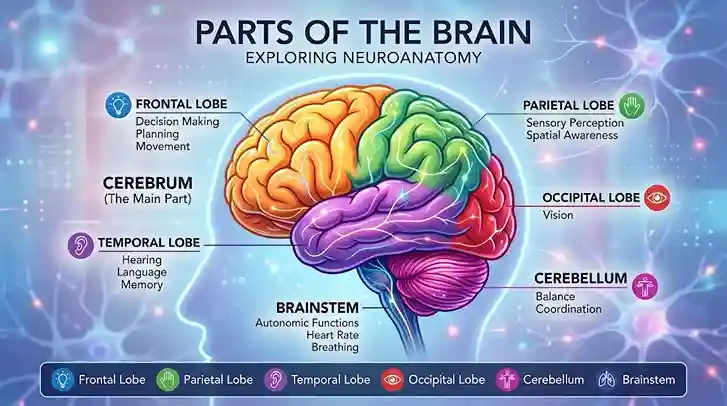
Your brain runs everything you think, feel, and do, yet most people cannot name more than two or three of its regions. That gap makes headaches, memory slips, and mood swings feel mysterious. This guide closes it. You will learn the main parts of the brain, what each one controls, and how they work as a team.
Parts of the Brain at a Glance
The parts of the brain fall into three major groups: the cerebrum, the cerebellum, and the brain stem. Deeper structures, such as the limbic system and the thalamus, sit inside and link these groups together.
Use this table as your map. Every row gets its own section below.
| Region | Location | Main job | Quick example |
| Cerebrum | Top and front, largest area | Thinking, senses, movement, language | Reading this sentence |
| Cerebellum | Back, below the cerebrum | Balance, coordination, motor learning | Riding a bike |
| Brain stem | Base, joins the spinal cord | Breathing, heartbeat, alertness | Breathing while you sleep |
| Limbic system | Deep, centre of the brain | Emotion, memory, motivation | Remembering a birthday |
| Thalamus | Deep, above the brain stem | Relays sensory signals | Passing sound to the hearing area |
| Hypothalamus | Deep, below the thalamus | Temperature, hunger, thirst, hormones | Feeling thirsty after a run |
| Basal ganglia | Deep, within the cerebrum | Smooth, planned movement | Starting a walk |
How Does the Brain Function as a Single System?
The brain is a three-pound organ built from billions of cells that pass signals to each other. No single region works alone. Each region sends and receives messages all day.
Researchers estimate that the human brain holds about 86 billion neurons, plus a similar number of support cells called glia (Herculano-Houzel, 2009). Neurons send electrical and chemical messages. Glia feed, protect, and clean around them.
It consumes about 20% of your energy but only makes up about 2% of your body weight. That is why a skipped meal or poor sleep slows your thinking fast.
Key entities in brain anatomy:
- Neurons: the signalling cells
- Glia: the support and repair cells
- Grey matter: cell bodies, where processing happens
- White matter: nerve fibres, the cables between regions
The Cerebrum: The Thinking Centre
The cerebrum is the largest of all the parts of the brain. It fills most of your skull and handles reasoning, language, vision, hearing, touch, and voluntary movement.
A deep groove splits the cerebrum into a left and a right hemisphere. A thick band of fibres called the corpus callosum connects them. The wrinkled outer layer, the cerebral cortex, packs a huge surface into a small space through folds.
The cerebrum does not do one job. It splits work across four lobes, covered next.
What Do the Four Brain Lobes Do?
Each hemisphere has four lobes. Together, these brain lobes cover most of what you notice about yourself: your personality, your senses, and your skills.
| Lobe | Location | Key functions | If damaged, you may notice |
| Frontal lobe | Behind the forehead | Planning, decisions, personality, speech, voluntary movement | Poor judgement, mood change, weak limbs |
| Parietal lobe | Top and rear | Touch, pain, temperature, spatial sense | Trouble judging space or feeling objects |
| Temporal lobe | Above the ears | Hearing, language understanding, memory | Hearing or memory problems |
| Occipital lobe | Back of the head | Vision | Blind spots or vision loss |
Frontal lobe: your control room
The frontal lobe lets you plan your day, hold back impulses, and speak. Its rear strip, the motor cortex, sends commands to your muscles. Broca’s area, usually on the left side, helps you form words.
Parietal lobe: your body map
The parietal lobe builds a map of your body and the space around it. It tells you where your hand is without looking. It also blends touch with sight so you can pick up a cup.
Temporal lobe: your sound and memory hub
The temporal lobe turns sound into meaning. Wernicke’s area, in the left temporal lobe for most people, helps you understand speech. The hippocampus, tucked inside, helps store new memories.
Occipital lobe: your vision processor
The occipital lobe receives signals from your eyes and builds the picture you see. Even small damage here can create gaps in your field of view.
The Cerebellum: The Balance and Coordination Expert
The cerebellum sits at the back of your head, under the cerebrum. It looks like a small, tightly ridged cauliflower. It makes up only about 10% of brain volume, yet it holds more than half of all neurons (Herculano-Houzel, 2009).
This part of the brain fine-tunes movement. It compares what you meant to do with what your body actually did, then corrects the gap in real time. That is how you catch a falling pen without thinking.
Scientists now link the cerebellum to more than motion. It also supports attention, timing, and some language tasks.
What the cerebellum controls:
- Balance and posture
- Smooth, accurate movement
- Learning motor skills, such as typing or swimming
- Timing and rhythm
The Brain Stem: The Life-Support Cable
The brain stem connects the brain to the spinal cord. It controls the automatic tasks that keep you alive, so you never need to think about them.
The brain stem has three sections:
| Section | Position | Main functions |
| Midbrain | Top | Eye movement, reflexes to sight and sound, alertness |
| Pons | Middle | Relays signals to the cerebellum, sleep cycles, facial sensation, chewing |
| Medulla oblongata | Bottom | Breathing, heart rate, blood pressure, swallowing, coughing |
Every signal travelling between your brain and body passes through this narrow stalk. Because of that, even a small injury to the brain stem can be life-threatening.
The Limbic System: Where Emotion Meets Memory
The limbic system is a ring of structures deep inside the brain. It links your feelings to your memories and shapes how you respond to the world.
| Structure | What it does | Everyday example |
| Hippocampus | Forms and stores new memories; helps with navigation | Learning your way around a new city |
| Amygdala | Detects threats; drives fear and strong emotion | Jumping at a loud bang |
| Cingulate gyrus | Links emotion to thought and pain response | Feeling distress during a conflict |
| Fornix | Carries signals out of the hippocampus | Recalling a recent conversation |
This is why a smell can bring back a childhood memory in seconds. The amygdala and hippocampus work as a pair. One tags the feeling, the other files the story.
Deep Brain Structures You Should Know
Several small structures sit near the centre of the brain. They are tiny, but you could not function without them.
- Thalamus: Acts as a switchboard. It routes sight, sound, and touch signals to the right area of the cortex.
- Hypothalamus: Keeps your body in balance. It manages temperature, hunger, thirst, sleep, and hormone release through the pituitary gland.
- Pituitary gland: Releases hormones that control growth, stress response, and reproduction.
- Basal ganglia: Help you start, stop, and smooth out movements. Parkinson’s disease affects this area.
- Pineal gland: Releases melatonin, which helps set your sleep rhythm.
How Do the Left and Right Hemispheres Differ?
The left hemisphere controls the right side of your body, and the right hemisphere controls the left. For most people, the left side leads language and the right side leads spatial tasks and face recognition.
The popular idea that people are either left-brained or right-brained is a myth. Brain imaging shows that both hemispheres work together on almost every task. The corpus callosum carries over 200 million fibres that keep them in constant conversation.
What Protects the Parts of the Brain?
Your brain is soft, so your body wraps it in several layers of defence. Each layer has a clear job.
| Layer | What it is | Role |
| Skull | Bone | Blocks direct impact |
| Meninges | Three membranes: dura mater, arachnoid mater, pia mater | Cover and cushion the brain and spinal cord |
| Cerebrospinal fluid (CSF) | Clear liquid in and around the brain | Floats the brain, absorbs shock, clears waste |
| Blood-brain barrier | Tight lining of blood vessels | Filters out harmful substances |
| Ventricles | Four connected fluid-filled spaces | Make and circulate CSF |
What Happens When Parts of the Brain Are Damaged?
Stroke, head injury, tumours, and disease can harm any region. The symptoms depend on which area is hurt, which is why doctors can often predict the damage site from the symptoms alone.
| Damaged area | Possible effects |
| Frontal lobe | Personality change, poor planning, speech trouble |
| Parietal lobe | Neglect of one side of the body, trouble with spatial tasks |
| Temporal lobe | Memory loss, trouble understanding speech |
| Occipital lobe | Vision loss |
| Cerebellum | Unsteady walking, shaky movement |
| Brain stem | Breathing, heartbeat, or consciousness problems |
| Hippocampus | Trouble forming new memories |
Call emergency services right away if you notice sudden weakness, face drooping, slurred speech, or a severe headache. Fast treatment saves brain tissue.
How Can You Protect Every Part of Your Brain?
You cannot swap out any of the parts of the brain, so daily habits matter. These steps have strong research support.
- Move your body. Aim for at least 150 minutes of moderate exercise each week. It improves blood flow and supports the hippocampus.
- Sleep 7 to 9 hours. Sleep lets the brain clear waste and lock in memories.
- Eat for your brain. Choose vegetables, fruit, whole grains, fish, nuts, and olive oil.
- Wear a helmet. Use one for cycling, motorbike riding, and contact sport.
- Control blood pressure and blood sugar. Both damage brain vessels over time.
- Stay curious. Learn a language, play an instrument, or pick up a new skill.
- Stay social. Regular contact with friends and family supports mood and memory.
- Avoid smoking and limit alcohol. Both shrink brain tissue over time.
Your Next Step
You now know the major parts of the brain and how they cooperate. Pick one habit from the protection list and start it today. A 20-minute walk, an earlier bedtime, or a helmet on your next ride all count.
If you spot symptoms that worry you, book a visit with a doctor. Share this guide with someone who is curious about how their mind works, and bookmark it as your go-to reference.