What Are Teeth Made Of? The Complete Guide to Your Tooth Structure
Introduction
You brush them twice a day. You flash them when you smile. But have you ever stopped to ask: what are teeth made of? Many people assume teeth are just hard white bones stuck in our mouths. That assumption is wrong.
Teeth are actually complex living structures made from four distinct tissues, each with a unique job. Understanding what your teeth are made of helps you protect them better—because once you know what’s inside, you realize just how much they need your care.
Table of Contents
| Section | Topic |
| 1 | The Four Layers of a Tooth |
| 2 | Enamel: The Hardest Substance in Your Body |
| 3 | Dentin: The Thick Middle Layer |
| 4 | Pulp: The Living Core |
| 5 | Cementum: The Root Protector |
| 6 | Teeth vs. Bones: What’s the Difference? |
| 7 | The Chemical Composition of Teeth |
| 8 | How Tooth Decay Affects Tooth Structure |
| 9 | Can Teeth Repair Themselves? |
| 10 | How to Protect Your Teeth |
| 11 | Frequently Asked Questions |
| 12 | Conclusion |
The Four Layers of a Tooth
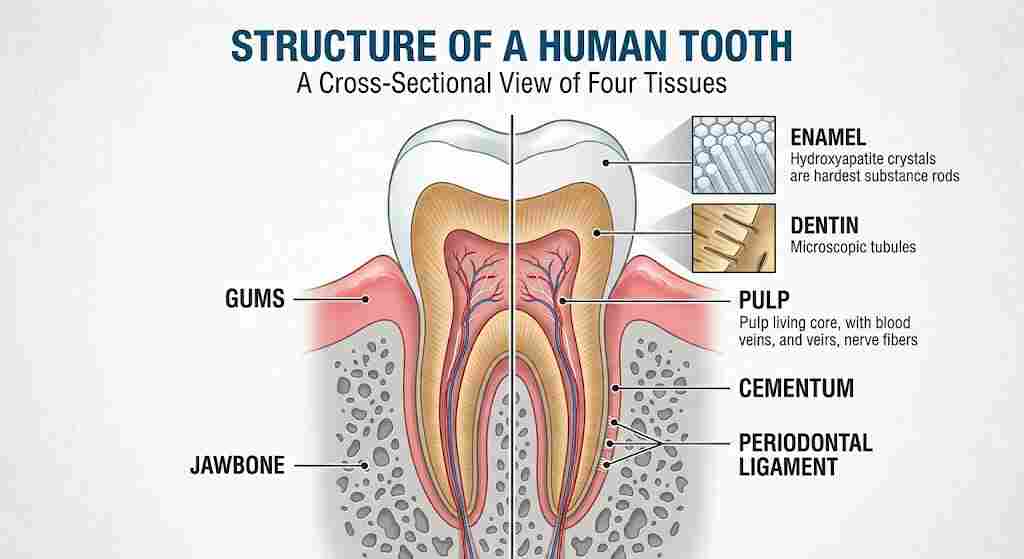
Every tooth in your mouth is made up of four dental tissues. Three of these tissues are hard and mineralized. One is soft and alive. Together, they form a structure strong enough to chew food for decades yet sensitive enough to detect a single grain of sand.
The four layers are:
- Enamel – the hard, white outer shell
- Dentin – the thick, supportive middle layer
- Pulp – the soft, living core
- Cementum – the protective covering on the root
Each layer plays a specific role. When you understand what teeth are made of layer by layer, you understand why cavities hurt, why teeth can feel sensitive, and why enamel loss is permanent.
Enamel: The Hardest Substance in Your Body
Enamel is typically the first material that comes to mind when someone asks, “What are teeth made of?” And for good reason—it’s the part you see when you smile.
Enamel is the outermost layer of your tooth. It covers the crown, the part above your gum line. This remarkable tissue is the hardest substance in the entire human body. It’s even harder than bone.
What Is Enamel Made Of?
Enamel is approximately 96% mineral by weight. The primary mineral is hydroxyapatite—a crystalline form of calcium phosphate with the chemical formula Ca₁₀(PO₄)₆(OH)₂.
The remaining 4% consists of:
- Water (about 3–4%)
- Organic material and proteins (about 1%)
These tiny hydroxyapatite crystals are arranged in long, thin rods called enamel rods or prisms. Each rod is about 4–5 micrometers in diameter and runs from the inner dentin all the way to the outer tooth surface.
Why Is Enamel So Strong?
The dense packing of hydroxyapatite crystals gives enamel its incredible hardness. On the Mohs scale of mineral hardness, enamel scores between 5.0 and 5.5—comparable to fluorite. This hardness allows your teeth to grind, tear, and crush food without wearing down quickly.
The Catch: Enamel Has No Living Cells
Here’s the critical thing to know about what teeth are made of: enamel contains no living cells. It is acellular and avascular. That means:
- Enamel cannot feel pain
- Enamel cannot heal itself
- Enamel cannot grow back once it’s gone
Once you lose enamel through decay, wear, or injury, it’s gone forever. A dentist can repair the damage with fillings or crowns, but your body cannot replace what was lost.
H2: Dentin: The Thick Middle Layer
Directly beneath the enamel lies dentin. If enamel is the armor, dentin is the body it protects.
Dentin makes up the bulk of your tooth. It’s a yellowish tissue that forms the main structure beneath the enamel on the crown and beneath the cementum on the root.
What Is Dentin Made Of?
Dentin is about 70% mineral (primarily hydroxyapatite), 20% organic material, and 10% water.
The organic portion is mostly Type I collagen. This collagen gives dentin flexibility and toughness—qualities that enamel lacks.
Dentin also contains microscopic tubules—tiny hollow channels that run through the tissue. These tubules connect the outer tooth surface to the nerves in the pulp.
Why Dentin Matters for Tooth Sensitivity
Have you ever felt a sharp zing when eating ice cream or drinking hot coffee? That’s dentin sensitivity. When enamel wears away, the dentin tubules become exposed.
Hot, cold, sweet, or acidic substances can travel through these tubules and stimulate the nerves inside the tooth.Dentin is softer than enamel but harder than bone. It provides a crucial cushion between the hard enamel and the sensitive pulp.
Pulp: The Living Core
Your tooth’s pulp is its innermost component. It’s the only soft tissue among the four layers that make up what teeth are made of.
What Is Pulp Made Of?
The pulp is composed of:
- Connective tissue
- Blood vessels
- Nerves
- Lymphatic tissue
On a wet-weight basis, the pulp is about 75% water and 25% organic material.
What Does the Pulp Do?
The pulp serves three vital functions:
- Sensory – The nerves in the pulp detect temperature, pressure, and pain. This is why toothaches hurt so much—the pulp is packed with nerve endings.
- Nutritive – Blood vessels carry oxygen and nutrients to keep the tooth alive.
- Formative – The pulp contains odontoblasts, specialized cells that produce dentin.
The pulp chamber sits in the center of the crown. From there, root canals extend down through the roots, carrying nerves and blood vessels into the jawbone.
Cementum: The Root Protector
The fourth tissue that answers the question “what are teeth made of” is cementum. This is the layer that covers the tooth root, below the gum line.
What Is Cementum Made Of?
Cementum is about 45–50% inorganic material (hydroxyapatite) and 50–55% organic material and water.
The organic portion is primarily Type I collagen—about 90% of the organic matrix.
What Does Cementum Do?
Cementum has one primary job: anchoring the tooth in place. It provides attachment for the periodontal ligament, the network of collagen fibers that connects your tooth to the surrounding jawbone.
Cementum is:
- Softer than dentin
- Avascular (no blood vessels)
- Capable of limited repair throughout life
Unlike enamel, cementum can regenerate to some degree, which helps keep your teeth stable in their sockets.
Teeth vs. Bones: What’s the Difference?
Many people assume teeth are bones. After all, they’re both hard, white, and made of calcium. But when you understand what teeth are made of, the differences become clear.
| Feature | Teeth | Bones |
| Primary mineral | Hydroxyapatite (up to 96% in enamel) | Hydroxyapatite (about 65%) |
| Living tissue | Pulp is living; enamel is not | Entirely living tissue |
| Collagen content | Low in enamel; higher in dentin/cementum | High (about 25% of weight) |
| Ability to heal | Enamel cannot heal; dentin can form limited reparative dentin | Bones heal and remodel continuously |
| Blood supply | Only in the pulp | Throughout the tissue |
| Nerves | Only in the pulp | Throughout the tissue |
| Regeneration | Limited to cementum and some dentin | Continuous regeneration |
The key takeaway: teeth are not bones. Teeth contain much higher mineral content and far less collagen than bones. And unlike bones, the hard outer layer of your teeth cannot repair itself.
The Chemical Composition of Teeth
Let’s dive deeper into chemistry. When scientists ask “what are teeth made of,” they’re looking at the molecular level.
Hydroxyapatite: The Star Mineral
The mineral that makes teeth hard is hydroxyapatite. Its chemical formula is Ca₁₀(PO₄)₆(OH)₂.
Hydroxyapatite is a form of calcium phosphate. The calcium and phosphate ions arrange themselves into a crystal lattice structure that gives teeth their incredible strength.
Trace Elements
Tooth mineral isn’t pure hydroxyapatite. It contains trace amounts of other elements:
- Carbonate – incorporated into the crystal structure, making it more soluble
- Fluoride – can replace hydroxide ions to form fluorapatite, which is more acid-resistant
- Magnesium – found in higher concentrations in dentin than in enamel
- Chloride – found in higher concentrations in enamel
Composition by Layer
| Tissue | Mineral Content | Organic Content | Water |
| Enamel | 96% | ~1% | 3–4% |
| Dentin | 70% | 20% | 10% |
| Cementum | 45–50% | 50–55% | — |
How Tooth Decay Affects Tooth Structure
Understanding what teeth are made of helps you understand how cavities form.
The Demineralization Process
When oral bacteria consume sweets and create acids, tooth decay starts. These acids attack the hydroxyapatite crystals in your enamel. When the pH in your mouth drops below about 5.5, the enamel begins to dissolve—a process called demineralization.
The Stages of Decay
- White spot lesion – The first sign of enamel demineralization. The enamel looks chalky white because minerals have been lost beneath the surface.
- Cavity formation – If demineralization continues, the enamel breaks down completely, forming a hole.
- Dentin involvement – The cavity reaches the dentin. Decay spreads faster here because dentin is softer and contains organic material.
- Pulp infection – Bacteria reach the pulp. This causes pain, inflammation, and potentially abscess.
Remineralization
Here’s the good news: early enamel damage can be reversed. When pH returns to normal, calcium and phosphate from your saliva can recrystallize back into the enamel—a process called remineralization.
Fluoride accelerates this process by:
- encouraging the production of fluorapatite, which has a higher acid resistance
- Inhibiting demineralization
- Enhancing remineralization
Can Teeth Repair Themselves?
The short answer is: it depends on which part of the tooth.
Enamel: No
Enamel cannot regenerate because it contains no living cells. The ameloblasts that produced enamel are lost after the tooth erupts. What’s gone is gone.
Dentin: Limited Repair
Dentin can form reparative dentin in response to injury or decay. Specialized cells called odontoblasts can produce new dentin to protect the pulp from further damage. This is why some cavities don’t reach the pulp—the tooth builds a defensive barrier.
Pulp: Can Heal
The pulp has some capacity to heal from mild inflammation. But severe infection usually requires root canal treatment.
Cementum: Limited Regeneration
Cementum can regenerate throughout life, helping to maintain the tooth’s attachment to the jawbone.
The bottom line: enamel is the only part of what teeth are made of that cannot repair itself. That’s why prevention matters so much.
How to Protect Your Teeth
Now that you know what teeth are made of, you can protect them better. Here’s how:
Brush Twice Daily with Fluoride Toothpaste
Fluoride strengthens enamel by converting hydroxyapatite into fluorapatite, which is more resistant to acid attack. Brush for two minutes, twice a day.
Floss Daily
Cavities often start between teeth where your brush can’t reach. Plaque and food particles are eliminated from these little areas by flossing.
Limit Sugary and Acidic Foods
Sugar feeds the bacteria that produce acid. Acid attacks enamel directly. Limit both to protect the hydroxyapatite crystals in your teeth.
Drink Water
Water helps wash away food particles and acid. Fluoridated water also helps strengthen enamel from the inside out.
Visit Your Dentist Regularly
Professional cleanings remove plaque that brushing misses. Your dentist can also spot early signs of decay before they become serious.
Chew Sugar-Free Gum
Chewing stimulates saliva production. Saliva is your mouth’s natural defense—it neutralizes acid and provides calcium and phosphate for remineralization.
Frequently Asked Questions
Q: What are teeth made of exactly?
Teeth are made of four tissues: enamel (96% mineral, mostly hydroxyapatite), dentin (70% mineral, 20% organic material), pulp (soft tissue with nerves and blood vessels), and cementum (45–50% mineral covering the root).
Q: Are teeth bones?
No, teeth are not bones. Teeth contain much higher mineral content and far less collagen than bones. Unlike bones, tooth enamel contains no living cells and cannot heal itself.
Q: Why can’t teeth heal themselves?
Tooth enamel contains no living cells, blood vessels, or nerves. Without these, enamel cannot repair damage from decay or wear. Only a dentist can fix enamel damage.
Q: What is the hardest part of a tooth?
The hardest material in the human body is enamel, which is also the toughest component of teeth. It’s composed of tightly packed hydroxyapatite crystals that provide exceptional strength and wear resistance.
Q: Can tooth enamel grow back?
No, tooth enamel cannot grow back. Once lost, it is gone forever. However, early-stage enamel damage can be reversed through remineralization using fluoride and minerals from saliva.
Q: What causes tooth sensitivity?
Tooth sensitivity occurs when enamel wears away and exposes the dentin underneath. Dentin contains tiny tubules that connect to the nerves in the pulp. Hot, cold, sweet, or acidic substances travel through these tubules and trigger nerve pain.
Conclusion
So, what are teeth made of? They’re made of four remarkable tissues working together: enamel, dentin, pulp, and cementum. Each layer has a unique composition and a specific job. Enamel gives you a hard, protective shell. Dentin provides the bulk and flexibility. Pulp keeps the tooth alive. Cementum anchors it in place.
Understanding what your teeth are made of isn’t just trivia—it’s knowledge that can save your smile. When you know that enamel cannot heal itself, you brush more carefully. When you know that dentin causes sensitivity, you protect your gums. When you know that pulp contains living nerves, you don’t ignore that toothache.
Your teeth are extraordinary structures. They’re stronger than bone yet sensitive enough to detect the finest textures. They’re mineralized like rock yet alive at their core. And they’re yours for life—so take care of them.
Take action today: Book a dental check-up. Switch to a fluoride toothpaste. Cut back on sugary drinks. Your teeth have been working for you every day since they erupted. Now it’s time to work for them.