Athletic Shoe Tongue: The Complete Guide to Comfort, Fit, and Performance
Introduction (PAS Formula)
Your run starts strong. Ten minutes in, a familiar annoyance strikes: the athletic shoe tongue has slid sideways, creating a pinch point that ruins your stride. That small flap of fabric controls whether your shoe feels like a custom fit or a constant irritant. This guide reveals exactly how the athletic shoe tongue works, why it fails, and how to choose shoes that keep your feet locked in and pain-free.
What Is an Athletic Shoe Tongue and Why Does It Matter?
The athletic shoe tongue is the padded flap positioned between your instep and the laces. It protects the top of your foot from lace pressure while locking your heel into place. A well-designed tongue disappears into the background. A poorly designed one becomes the single most distracting part of your workout.
This small component influences three critical performance factors:
- Pressure distribution across the instep during tight lacing
- Foot stability inside the shoe during lateral movements
- Breathability that controls heat and moisture buildup
Runners, basketball players, and hikers all depend on the athletic shoe tongue to deliver a secure, blister-free experience. Understanding its anatomy transforms how you evaluate every pair you try on.
Anatomy of an Athletic Shoe Tongue: Parts You Should Know
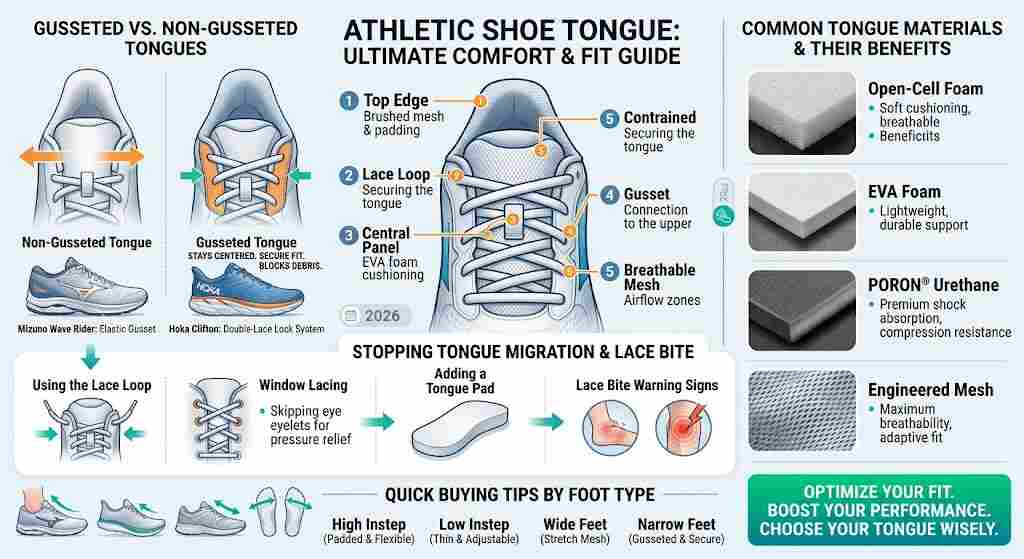
Manufacturers build the athletic shoe tongue from several distinct zones. Each zone addresses a different pressure point along your foot.
| Tongue Zone | Location | Primary Function | Common Materials |
| Top edge | Near ankle collar | Prevents lace pressure on ankle tendons | Brushed mesh, suede |
| Central panel | Over the instep | Distributes lace tension evenly | Open-cell foam, EVA |
| Base/gusset | Near toe box | Anchors tongue to prevent migration | Stretch mesh, elastic fabric |
| Lace loop | Center-top of tongue | Secures laces through the tongue | Woven nylon, reinforced fabric |
| Padding layer | Throughout | Cushions impact and lace bite | Polyurethane foam, PORON® |
Each zone serves a purpose. The top edge often carries a logo and a lace loop. The central panel absorbs the brunt of lace tension. The base determines whether the tongue stays centered or wanders toward your ankle.
The Core Functions of an Athletic Shoe Tongue
Every athletic shoe tongue performs four essential jobs. Remove any one of them, and the shoe loses comfort and performance.
Protecting the Instep From Lace Pressure
Tight laces concentrate force across a narrow band of your foot. Without adequate padding, that pressure irritates the extensor tendons running across the top of the foot. A well-padded athletic shoe tongue spreads that force across a wider area.
Locking the Foot Into the Shoe
The tongue works with the laces to create a secure midfoot wrap. This lockdown prevents your foot from sliding forward during downhill runs or sudden stops. Gusseted designs extend this lockdown by connecting the tongue to the shoe’s sides.
Managing Heat and Moisture
Perforated or mesh tongue panels allow air to circulate over the instep. Breathable materials move sweat away from the skin, keeping feet cooler and reducing blister risk during long efforts.
Preventing Tongue Migration
The most common complaint among runners involves the athletic shoe tongue sliding sideways. Lace loops, gussets, and strategic padding all combat this movement. When these features fail, the tongue bunches against your ankle and creates friction.
Athletic Shoe Tongue Materials: A Complete Breakdown
Material choice determines how the athletic shoe tongue feels, performs, and lasts. Manufacturers combine multiple layers to balance cushioning, weight, and durability.
Open-Cell Polyurethane Foam
Open-cell polyurethane foam dominates tongue padding. This material compresses under lace tension and returns to shape, absorbing pressure without adding bulk. It breathes better than closed-cell alternatives but breaks down faster with heavy use.
EVA Foam Padding
Ethylene-vinyl acetate (EVA) foam offers a lightweight, resilient cushioning option. High-elastic closed-cell EVA grades resist compression and maintain their thickness after thousands of flex cycles. Many performance shoes use EVA in the tongue for its balance of weight and support.
PORON® Performance Urethane
PORON® urethane provides superior shock absorption in a thin profile. Podiatrists frequently recommend this material for tongue padding because it resists compression and delivers consistent cushioning without adding height. Shoes built for high-impact activities often feature PORON® in the tongue and collar.
Engineered Mesh and Knit Uppers
Modern tongue exteriors use engineered mesh or knitted fabrics. These materials allow airflow, conform to foot shape, and reduce overall shoe weight. Jacquard knit constructions create zones of varying stretch and breathability within a single tongue panel.
Neoprene and Stretch Fabrics
Neoprene tongue linings stretch to accommodate different foot volumes. This material conforms to the instep and distributes pressure evenly, making it popular in cycling shoes and performance runners. Neoprene’s moisture resistance also helps in wet conditions.
Gusseted vs. Non-Gusseted Tongues: Which Design Wins?
The gusset determines whether your athletic shoe tongue stays put or becomes a constant nuisance.Only the top of the shoe is where a non-gusseted tongue attaches. It floats freely, allowing wide openings for easy entry. The trade-off: it slides sideways during movement.
A gusseted tongue connects to the shoe’s upper along one or both sides. This attachment creates a sleeve that keeps the tongue centered. Mizuno’s Wave Rider series uses a gusseted tongue with stretch lining that hugs the foot without stress. Hoka’s Clifton line employs a double-lace lock system to prevent tongue migration, paired with a padded tongue that sits comfortably against the skin.
Partially gusseted designs attach on one side only. This compromise allows easier entry while reducing lateral slide. The Hoka Bondi 8 uses a partially gusseted tongue to prevent irritation and chafing.
Quick Comparison
| Feature | Gusseted Tongue | Non-Gusseted Tongue |
| Tongue migration | Minimal | Frequent |
| Ease of entry | Moderate | Easy |
| Midfoot lockdown | Excellent | Basic |
| Debris protection | High | Low |
| Weight | Slightly heavier | Lighter |
How to Stop an Athletic Shoe Tongue From Sliding
Tongue migration ranks as the top fit complaint among runners. A 2025 Runner’s World review of the Adidas Adizero Evo SL noted that testers marked down the shoe primarily because “the tongue slides to the side when you run”. The problem is universal, but the solutions are straightforward.
Use the Tongue’s Lace Loop
Most athletic shoe tongues include a fabric loop at the top. Thread your laces through this loop before tying. The loop anchors the tongue to the lacing system and prevents sideways drift.
Try Window Lacing for Pressure Relief
Window lacing skips the crisscross pattern over the painful area. Thread laces straight up each side to create a gap over the irritated spot, then resume normal lacing above it. This technique relieves lace bite and reduces tongue pressure.
Add a Tongue Pad
Cut a small piece of foam or moleskin and place it beneath the athletic shoe tongue. This DIY pad cushions the irritated area from lace pressure and provides immediate relief during runs.
Choose Gusseted Models
The simplest long-term fix: buy shoes with gusseted tongues. The Adidas Adizero Evo SL Woven update solved the original model’s tongue migration with “a proper gusseted tongue that stays put and dramatically improves lockdown and comfort”.
Lace Bite: When the Athletic Shoe Tongue Fails You
Lace bite describes the sharp or aching pain across the top of the foot where laces sit. Repeated pressure from tight laces and the athletic shoe tongue irritates the extensor tendons. Runners with high arches face higher risk because the top of the foot sits closer to the laces.
Warning Signs
- Sharp pain across the instep during or after runs
- Redness or swelling beneath the tongue
- Pain that worsens with hill running or mileage increases
- Discomfort that changes your stride
Immediate Fixes
- Loosen laces before runs and adjust after the first mile
- Ice the irritated area for 10-15 minutes after activity
- Switch to softer socks to reduce friction
- Rotate shoes with more flexible tongues while symptoms calm down
Persistent lace bite that doesn’t improve with lacing adjustments warrants a visit to a sports medicine professional.
Athletic Shoe Tongue Innovations: From 1929 to Today
The athletic shoe tongue has evolved through nearly a century of patented improvements.
1929: The First Anti-Slip Tongue
Amos A. Smith patented a shoe tongue with an eyelet secured in the upper portion. The laces passed through this eyelet before tying, which “positively retained the tongue against any sidewise or downward movement”.
1984: Breathable Perforated Design
Marcel Schmid’s patent introduced a tongue with a padded front surface and multiple orifices containing porous material. This construction provided ventilation while maintaining protection against lace pressure and shock.
2012: Tongue Centralizer Assembly
Inventors developed a binding post and centralizer band that prevented tongues from moving laterally or longitudinally in any laced shoe.
2015: Differential Cushioning Zones
Nike’s patent described a tongue with medial, lateral, central, and top portions that provided “differential cushioning and support against pressure applied by a fastening system”.
2024-2025: Integrally Knit Tongues
Modern patents describe knitted components with ridge and channel structures that bias the tongue to curl into position. These designs integrate the tongue directly into the upper’s knit construction, eliminating seams and reducing weight.
How to Choose the Right Athletic Shoe Tongue for Your Foot
Foot shape determines which tongue design works best for you.
High Instep
Choose a tongue with generous padding and a flexible base. Rigid tongues increase lace bite risk. Look for gusseted designs with stretch panels that accommodate a higher instep without excessive pressure.
Low Instep
Thinner tongues work better for low-volume feet. Excessive padding creates dead space that allows the foot to slide. Seek shoes with adjustable gussets or thinner foam layers.
Wide Feet
Engineered mesh tongues with four-way stretch conform to wider feet without pinching. Avoid stiff, leather-backed tongues that resist stretch.
Narrow Feet
Look for tongues with a lace loop and gusseted construction. These features pull the tongue tight against a narrower instep and prevent lateral slide.
Daily Care for Your Athletic Shoe Tongue
Proper care extends tongue life and preserves comfort.
- Air-dry after every use. Moisture breaks down foam padding and encourages odor-causing bacteria.
- Clean mesh tongues with a soft brush. Use mild soap and cold water. Avoid machine washing, which distorts padding.
- Rotate shoes. Alternating pairs gives the tongue’s foam time to recover its shape between runs.
- Check the gusset stitching. Loose stitches allow the tongue to migrate. Repair them early.
- Replace worn tongues. Many brands sell replacement insoles but few sell tongues. When the padding flattens permanently, it’s time for new shoes.
Frequently Asked Questions About the Athletic Shoe Tongue
What is the purpose of an athletic shoe tongue?
The athletic shoe tongue protects the instep from lace pressure, locks the foot into the shoe, manages heat and moisture, and prevents lace bite. It works with the laces to create a secure, comfortable midfoot wrap.
Why does my athletic shoe tongue keep sliding to the side?
Non-gusseted tongues slide because nothing anchors them laterally. Thread your laces through the tongue’s loop, try window lacing, or switch to shoes with gusseted tongues that connect to the upper on one or both sides.
What is a gusseted tongue?
A gusseted tongue attaches to the shoe’s upper along one or both sides, creating a sleeve that keeps the tongue centered. This design reduces migration, improves lockdown, and blocks debris from entering the shoe.
How do I stop lace bites from my shoe tongue?
Loosen your laces, try window lacing to skip the painful area, add a foam pad beneath the tongue, and ice the irritated area after activity. If pain persists, consult a sports medicine professional.
Can I replace the tongue in my athletic shoes?
Most manufacturers don’t sell replacement tongues. A cobbler may be able to graft a new tongue onto your shoe, but the cost often approaches the price of new shoes. When padding flattens permanently, replacement is the practical choice.
Do thicker shoe tongues provide better cushioning?
Not always. Thicker tongues add weight and can create dead space that allows foot sliding. The best cushioning comes from material quality—like PORON® or high-elastic EVA—not thickness alone.
Conclusion: Your Next Step Toward Better Runs
The athletic shoe tongue controls comfort, fit, and performance more than any other small component. Check your current shoes: does the tongue stay centered? Does it cushion without pressure? If not, you now have the tools to fix it. Try the lace loop trick. Test window lacing. When it’s time for new shoes, prioritize gusseted designs with breathable, high-quality padding. Your feet will thank you on every mile.