DDS Meaning: The Complete Guide to Doctor of Dental Surgery and Beyond
Introduction
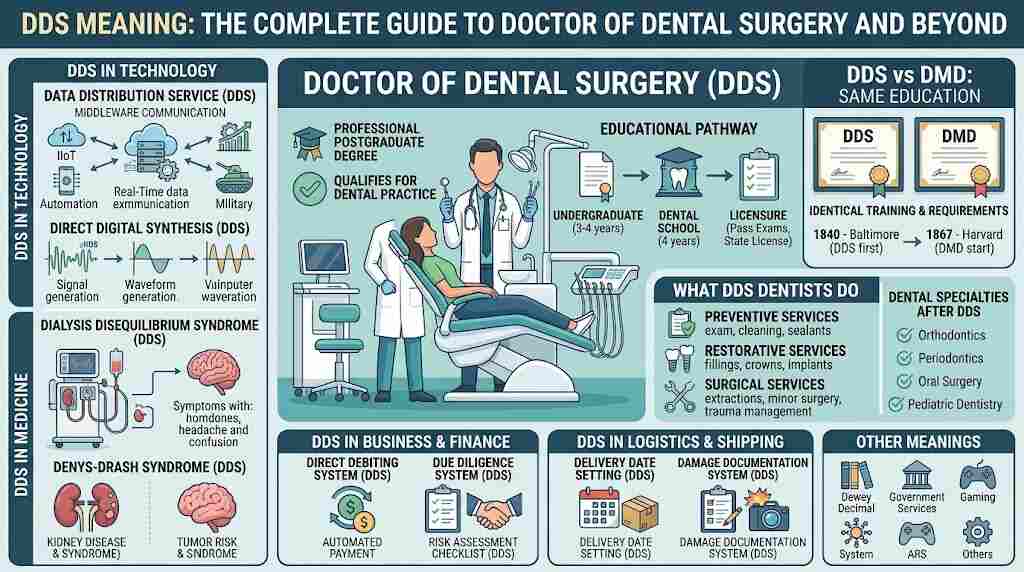
You have seen the letters “DDS” after a dentist’s name and wondered what they stand for. DDS meaning is straightforward: Doctor of Dental Surgery. This professional degree qualifies graduates to practice dentistry, diagnose oral conditions, and perform surgical procedures on teeth and gums.
But DDS also carries other meanings across technology, medicine, and business. This guide explains everything you need to know about the DDS meaning in every context.
What Is a DDS Degree?
The DDS meaning that most people encounter is Doctor of Dental Surgery. This is a professional postgraduate degree awarded to individuals who complete an accredited dental program. The DDS degree represents the standard qualification for practicing general dentistry in the United States and many other countries.
The University of Maryland School of Dentistry (formerly Baltimore College of Dental Surgery) awarded the first DDS degrees in 1840. Since then, this credential has become the gold standard for dental professionals worldwide.
A DDS degree signifies that the holder has completed rigorous training in oral health, dental surgery, and patient care. The DDS meaning extends beyond a simple title—it represents years of study, clinical practice, and commitment to maintaining public oral health.
Key Facts About the DDS Degree
- Professional postgraduate degree
- Typically requires four years of dental school
- Leads to licensure as a general dentist
- Equivalent to the DMD degree in educational requirements
DDS vs DMD: What Is the Difference?
One of the most common questions about DDS meaning involves its relationship to DMD. People often ask: Is a DDS better than a DMD? The answer might surprise you.
There is no difference between these two degrees.
The American Dental Association (ADA) has clarified that DDS (Doctor of Dental Surgery) and DMD (Doctor of Medicine in Dentistry or Doctor of Dental Medicine) represent the same education and training. Dentists with either credential have completed identical curriculum requirements set by the Commission on Dental Accreditation (CODA).
Why Are There Two Different Names?
The existence of two names for the same degree comes down to history and institutional preference:
- 1840: Baltimore College of Dental Surgery began awarding DDS degrees
- 1867: Harvard University established its dental school and chose to use Latin names for degrees
- Harvard translated DDS to “Chirurgae Dentium Doctoris” but did not favor this name
- They instead used “Doctoris Medicinae Dentariae,” which became DMD
Today, some dental schools award DDS while others award DMD. Both credentials carry equal weight and authority in the dental profession.
What This Means for Patients
When choosing a dentist, the DDS meaning versus DMD meaning should not influence your decision. The credential tells you which school they attended, not their skill level or expertise. Focus instead on:
- Clinical experience and specialization
- Communication style and professionalism
- Range of services offered
- Patient reviews and reputation
How to Become a DDS Dentist
The path to earning a DDS degree demands dedication and academic excellence. Understanding the DDS meaning requires appreciating the journey behind the credential.
Educational Pathway
Undergraduate Education (3-4 years)
Most dental schools require at least three years of undergraduate study, though most applicants complete a bachelor’s degree. Prerequisite courses typically include:
- Biology
- Chemistry (general and organic)
- Physics
- Biochemistry
- Mathematics
Dental School (4 years)
The DDS program itself spans four academic years:
Years 1-2: Basic Sciences
Students study biomedical sciences including anatomy, biochemistry, histology, microbiology, pathology, pharmacology, and physiology. Pre-clinical technical courses teach fundamental dental procedures on mannequins and models.
Years 3-4: Clinical Training
Students transition to treating actual patients under faculty supervision. They gain hands-on experience in:
- Diagnosis and treatment planning
- Restorative dentistry
- Periodontics
- Oral surgery
- Pediatric dentistry
- Prosthodontics
Licensure Requirements
After graduating with a DDS degree, dentists must:
- Pass the National Board Dental Examination (written)
- Pass a state or regional clinical licensing examination
- Pass a jurisprudence examination on state laws
- Complete continuing education to maintain licensure
What DDS Dentists Do
The DDS meaning in practice involves maintaining oral health and treating disorders of the teeth, gums, mouth, and tongue. DDS dentists provide comprehensive dental care including:
Preventive Services
- Routine cleanings and examinations
- Dental sealants and fluoride treatments
- Oral cancer screenings
- Patient education on oral hygiene
Restorative Services
- Fillings for cavities
- Crowns and bridges
- Dental implants
- Root canal therapy
- Dentures and partials
Surgical Services
- Tooth extractions
- Minor oral surgery
- Treatment of dental infections
- Management of dental trauma
Dental Specialties After DDS
Many dentists pursue additional training after earning their DDS degree. Specialty programs range from two to six years depending on the field. Recognized dental specialties include:
| Specialty | Focus Area |
| Orthodontics | Correcting misaligned teeth and jaws |
| Periodontics | Treating gum disease and supporting structures |
| Endodontics | Root canal treatment and dental pulp |
| Prosthodontics | Replacing missing teeth with crowns, bridges, and implants |
| Oral and Maxillofacial Surgery | Surgical procedures of the mouth, face, and jaws |
| Pediatric Dentistry | Dental care for children and adolescents |
| Oral Pathology | Diagnosis of oral diseases |
DDS Meaning in Technology
Beyond dentistry, DDS meaning extends into the technology sector with several important definitions.
Data Distribution Service (DDS)
The Data Distribution Service (DDS) is an Object Management Group (OMG) standard for real-time data exchange in distributed systems. This DDS meaning describes a middleware technology that enables:
- High-performance, dependable communication between system components
- Data-centric publish-subscribe messaging
- Scalable architecture for industrial systems
- Real-time data connectivity for IoT and IIoT applications
DDS in this context is widely used in:
- Industrial automation
- Military and defense systems
- Transportation and aerospace
- Healthcare technology
- Smart grid infrastructure
Direct Digital Synthesis (DDS)
Direct Digital Synthesis (DDS) is a method for generating analog waveforms from digital signals. This DDS meaning applies to:
- Signal generation in communication systems
- Function generators and test equipment
- Local oscillators in radio frequency applications
- Digital sound synthesis
A DDS system typically consists of:
- A frequency reference (clock source)
- A numerically controlled oscillator (NCO)
- A digital-to-analog converter (DAC)
The advantages of Direct Digital Synthesis include rapid frequency switching, fine frequency resolution, and precise phase control.
Digital Data Service (DDS)
Digital Data Service refers to dedicated communication lines for transmitting digital data. This DDS meaning covers private line channels with data rates from 2.4 to 64 Kbps.
DDS Meaning in Medicine
In medical contexts, DDS meaning can refer to several conditions and syndromes.
Dialysis Disequilibrium Syndrome (DDS)
Dialysis Disequilibrium Syndrome is a neurological complication of hemodialysis. This DDS meaning describes symptoms that occur during or after dialysis treatment, particularly in patients:
- Newly starting hemodialysis
- Returning after missing multiple sessions
Symptoms range from mild to severe:
- Headache and nausea
- Blurred vision
- Restlessness and confusion
- Seizures (rare)
- Coma (rare)
The condition occurs due to osmotic imbalances between blood and brain tissue during dialysis.
Denys-Drash Syndrome (DDS)
Denys-Drash Syndrome is a rare genetic disorder characterized by:
- Diffuse mesangial sclerosis (kidney disease)
- Intersex anatomy
- Increased risk of Wilms’ tumor (kidney cancer)
DDS Meaning in Business and Finance
The DDS meaning appears in various business and financial contexts.
Direct Debiting System (DDS)
A Direct Debiting System enables companies to automatically collect payments from customers or dealers. This DDS meaning applies to:
- Automated cash management
- Forward and cash collection systems
- Dealer and franchise payment processing
- Receivables management
Benefits include improved cash flow, reduced administrative burden, and faster payment collection.
Due Diligence System (DDS)
A Due Diligence System helps organizations assess and manage risks related to environmental, legal, and ethical compliance. This DDS meaning has gained prominence with regulations like the EU Deforestation Regulation (EUDR), which requires due diligence statements for certain products.
Daily Direction Setting (DDS)
In Lean Manufacturing, Daily Direction Setting establishes clear, actionable objectives for each day. This DDS meaning focuses on:
- Minimizing waste and maximizing value
- Ensuring everyone understands daily priorities
- Aligning individual work with organizational goals
Dollar Denominated Securities (DDS)
In finance, DDS refers to securities denominated in US dollars traded on stock exchanges.
DDS Meaning in Logistics and Shipping
The DDS meaning in logistics covers several important concepts.
Delivery Date Setting (DDS)
Delivery Date Setting is a critical decision in manufacturing and supply chain management. This DDS meaning involves:
- Planning production and delivery schedules
- Coordinating with suppliers and customers
- Managing customer expectations
- Optimizing inventory and capacity
Damage Documentation System (DDS)
A Damage Documentation System tracks and records damage to shipped goods. This helps:
- Detect accidental handling damage
- Prevent tampering
- Support insurance claims
- Improve quality control
Due Diligence Statement (DDS)
In international trade, particularly with EU regulations, a Due Diligence Statement documents compliance with environmental and legal requirements. Companies placing products on the EU market must submit these statements.
Other DDS Meanings
The DDS meaning extends to numerous other fields and contexts:
| Field | DDS Meaning |
| Government | Department of Developmental Services |
| Government | Disability Determination Services |
| Government | Department of Driver Services |
| Education | Dewey Decimal System |
| Gaming | Digital Devil Saga (video game) |
| Anime | Digimon Data Squad |
| Tools | Dual Drum Sander |
| Fraternities | Delta Delta Sigma |
The DDS meaning always depends on context. Understanding which definition applies requires looking at the surrounding subject matter.
Frequently Asked Questions
What does DDS stand for in dentistry?
DDS stands for Doctor of Dental Surgery. It is the professional degree awarded to dentists who complete accredited dental school programs. DDS dentists are qualified to diagnose, treat, and prevent oral health conditions.
Is a DDS the same as a DMD?
Yes, DDS and DMD are the same degree with identical educational requirements. The difference is only in the name, which depends on which dental school awarded the degree. Both credentials qualify graduates to practice general dentistry.
How long does it take to get a DDS degree?
Becoming a DDS typically requires three to four years of undergraduate education followed by four years of dental school. Some programs offer accelerated paths, but the standard timeline is seven to eight years of higher education.
What can a DDS dentist do?
A DDS dentist can perform all aspects of general dentistry, including preventive care, restorative treatments, and surgical procedures. They diagnose oral conditions, treat dental problems, and help patients maintain optimal oral health.
What does DDS mean in technology?
In technology, DDS most commonly refers to Data Distribution Service (a middleware standard for real-time systems) or Direct Digital Synthesis (a method for generating analog waveforms). The specific DDS meaning depends on the technical context.
Do DDS dentists need to specialize?
No, most DDS dentists practice general dentistry without additional specialization. However, those who wish to specialize in areas like orthodontics, periodontics, or oral surgery must complete additional training programs lasting two to six years.
Choose Your Dentist with Confidence
The DDS meaning ultimately comes down to trust. When you see those three letters after a dentist’s name, you know they have completed the rigorous education and training required to care for your oral health.
Whether your dentist holds a DDS or a DMD, they have earned the right to care for your smile. Their education matches that of medical doctors in depth and intensity. They have passed national and state examinations. They continue learning throughout their careers to stay current with the latest advances in dental science.
The next time you visit the dentist, you will understand exactly what DDS means and why it matters. Share this knowledge with family and friends who might wonder about those letters after their dentist’s name.