Is Heart Disease Left Bundle Branch Block Dangerous? A Plain-English Guide
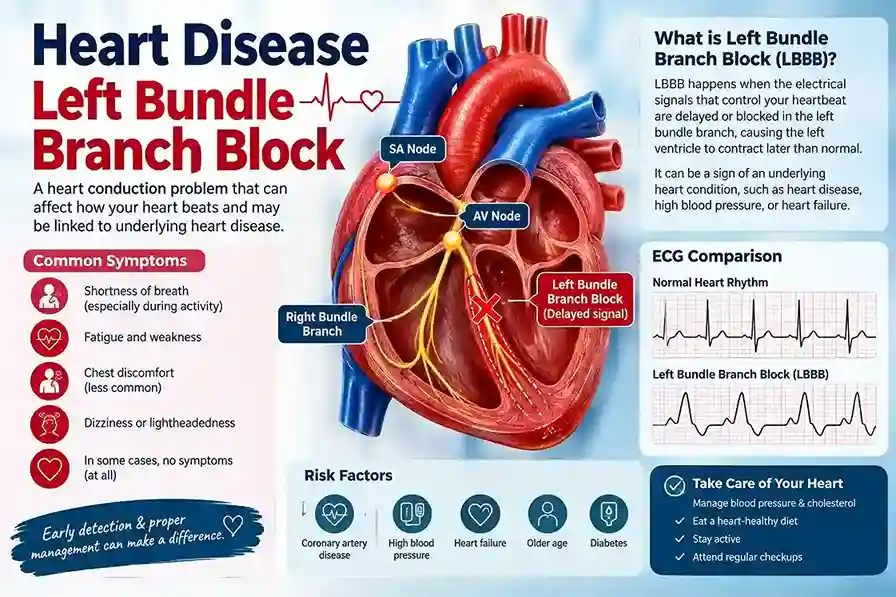
Your ECG report says “left bundle branch block,” and your mind jumps straight to heart attack. That fear is fair, but it does not tell the whole story. Heart disease left bundle branch block ranges from a harmless wiring quirk to a warning sign of a weakened heart. This guide shows you which is which, which tests matter, and when treatment helps.
What Is Left Bundle Branch Block?
Left bundle branch block (LBBB) is a delay or blockage in the left branch of your heart’s electrical system. The left ventricle, your main pumping chamber, then receives its signal late. The right ventricle fires on time, so the two sides beat slightly out of step.
You cannot feel this delay. A doctor spots it on an electrocardiogram (ECG), a quick test that records your heart’s electrical activity.
| Term | Plain meaning |
| LBBB | The left branch of the wiring is slow or blocked |
| ECG | A tracing of your heart’s electrical signals |
| QRS complex | The part of the ECG that shows the ventricles firing |
| Ventricle | A lower pumping chamber |
How the Heart’s Wiring Works
Think of your heart as a house with a fuse box. The signal starts in the sinoatrial node, the heart’s natural pacemaker. It crosses the upper chambers and reaches the atrioventricular (AV) node.
From there, the signal enters the bundle of His and splits into a right and a left bundle branch. The left branch then divides again into the anterior and posterior fascicles. Each branch carries the signal to its ventricle in a fraction of a second.
In LBBB, the left route is damaged or slow. The signal still reaches the left ventricle, but it takes a detour through muscle instead of the fast lane.The ECG’s QRS complex widens as a result of the diversion.
Is Heart Disease Left Bundle Branch Block Always Serious?
No. Heart disease left bundle branch block does not carry one fixed meaning. The block can appear on its own in an otherwise healthy older adult, or it can signal damage to the heart muscle.
Here is the key point: LBBB is a finding, not a diagnosis of a specific disease. Doctors treat the cause behind it, not the block itself.
- Isolated LBBB: no symptoms, normal pumping strength, and no other heart problem found.
- LBBB with heart disease: the block sits alongside coronary artery disease, cardiomyopathy, valve disease, or heart failure.
- New-onset LBBB: a block that was not on earlier ECGs. It deserves a prompt, careful workup.
The block is rare in young, healthy people. It becomes more common with age, and it is more likely to mean something when it shows up in a person with other heart problems.
What Causes Left Bundle Branch Block?
Damage to the left ventricle is frequently the cause of left bundle branch block in heart disease. Scarring, stretching, or inflammation can all injure the wiring. Sometimes no clear cause turns up, and doctors call that “idiopathic.”
| Cause | How it affects the wiring |
| Coronary artery disease | Reduced blood flow injures the conduction tissue |
| Prior heart attack | Scar tissue interrupts the signal path |
| High blood pressure | Long-term strain thickens the left ventricle |
| Dilated cardiomyopathy | A stretched, weakened ventricle disturbs the wiring |
| Aortic valve disease | Pressure and calcium near the valve press on the left branch |
| Myocarditis | Inflammation temporarily or permanently disrupts the signal |
| Amyloidosis | Abnormal protein deposits stiffen the heart |
| Lyme disease | Infection can inflame the conduction system |
| Heart surgery or ablation | A procedure can injure the left bundle branch |
| Age-related fibrosis | Slow scarring of the conduction system, no other cause |
A few causes are reversible. Myocarditis or an electrolyte imbalance can produce a block that fades once the trigger is treated.
What Are the Symptoms?
Most people with LBBB feel nothing at all. They often learn about it by accident, during a routine ECG before surgery or a physical.
When symptoms do appear, they usually come from the underlying heart condition, not the block itself. Watch for:
- Shortness of breath during normal activity
- Fatigue that does not improve with rest
- Swelling in the ankles or legs
- Dizziness or lightheadedness
- Fainting or near-fainting
- A slow or skipping heartbeat
- Chest discomfort
Fainting deserves special attention. It can mean the block is progressing toward a more serious conduction problem.
How Doctors Diagnose Heart Disease Left Bundle Branch Block
Doctors confirm LBBB with a 12-lead ECG. A diagnosis of heart disease left bundle branch block takes more than the ECG, though. The ECG finds the block, and the next tests look for the cause.
| Test | What it shows |
| 12-lead ECG | Confirms the block, with a QRS of 120 milliseconds or longer |
| Echocardiogram | Pumping strength (ejection fraction), valve function, wall thickness |
| Stress test | How the heart behaves under exertion |
| Holter or event monitor | Rhythm problems that come and go |
| Cardiac MRI | Scar, inflammation, or deposits in the muscle |
| Coronary CT or angiography | Blocked arteries |
| Blood tests | Electrolytes, thyroid function, cholesterol, and heart strain markers |
On the ECG, doctors look for a wide QRS, a broad notched R wave in the left-sided leads, and T waves that point opposite to the QRS. The ejection fraction is the number most worth knowing. It tells you what percentage of blood the left ventricle pumps out with each beat.
LBBB vs. RBBB vs. Heart Block: Know the Difference
These terms sound alike but describe different problems.
| Condition | Where the problem sits | Typical meaning |
| Left bundle branch block | Left branch below the AV node | Often tied to left ventricle disease |
| Right bundle branch block | Right branch below the AV node | Often harmless, though not always |
| AV (heart) block | At the AV node | Signal slows between upper and lower chambers |
| Fascicular block | Part of the left branch only | A partial delay |
Many people hear “heart block” and picture a blocked artery. A bundle branch block is an electrical issue and has nothing to do with clogged vessels, although coronary disease can be one of its causes.
LBBB and Heart Attack: Why They Get Confused
A heart attack and LBBB can look alike on an ECG. The wide QRS changes the tracing and can hide the classic signs of an attack.
Emergency teams treat chest pain with a new LBBB seriously. They compare your ECG with older tracings, check blood tests for heart muscle injury, and apply special ECG rules, such as the Sgarbossa criteria, to separate a block from an attack.
Having heart disease left bundle branch block does not mean you are having a heart attack. It does mean that chest pain, breathlessness, or sweating needs fast medical attention instead of a wait-and-see approach. Keep a copy of your latest ECG on your phone. It saves the emergency team valuable time.
Risks and Complications
Many people with isolated LBBB live for decades without trouble. The risk depends on the cause and on how well the heart pumps.
- Heart failure: The late contraction makes the left ventricle work less efficiently. In a weak heart, this worsens the problem.
- Dyssynchrony: The two sides of the heart contract out of sync, which can weaken the muscle over time.
- Progression to complete heart block: If both branches fail, the signal may not reach the ventricles at all. This can cause fainting and often needs a pacemaker.
- Higher cardiovascular risk: In older adults with coronary artery disease, heart disease left bundle branch block is linked to greater risk of death, because the block marks more advanced heart damage.
A small group develops “LBBB-induced cardiomyopathy,” where the block itself gradually weakens a once-healthy heart. Regular echocardiograms catch this early.
Treatment Options
No pill removes the block. Treatment targets the cause, the symptoms, and the pumping strength. For heart disease left bundle branch block, the plan depends on what your tests show.
| Situation | Typical approach |
| No symptoms, normal heart function | Routine follow-up and periodic ECG or echo |
| Underlying coronary disease | Medication, lifestyle changes, or procedures to restore blood flow |
| High blood pressure | Blood pressure control to protect the left ventricle |
| Heart failure | Guideline-directed medicines, and sometimes a device |
| Fainting from slow heart rate | Pacemaker |
| Reversible cause (myocarditis, electrolytes) | Treat the trigger and recheck the ECG |
Your cardiologist will set the follow-up schedule. Do not skip those visits, even when you feel fine.
Cardiac Resynchronization Therapy and Newer Pacing
Cardiac resynchronization therapy (CRT) is a special pacemaker. It sends small pulses to both ventricles so they contract together again. Doctors consider it for people who have heart failure, a reduced ejection fraction, and LBBB with a wide QRS.
Guidelines favor CRT most strongly when the ejection fraction is 35% or lower, symptoms persist despite medicine, and the QRS is very wide. Heart disease left bundle branch block responds to CRT better than most other conduction patterns, which is why doctors look for it.
Some centers now use conduction system pacing, including left bundle branch area pacing. This method places the lead deep in the septum to restore the natural wiring path. It is a growing option, so ask your electrophysiologist whether it fits your case.
Living Well With LBBB
Daily habits protect the heart muscle behind the wiring problem. Small steps add up.
- Keep blood pressure in the range your doctor sets.
- Take prescribed medicines exactly as directed.
- Treat high cholesterol and diabetes.
- Stop smoking, and limit alcohol.
- Stay active with walking, cycling, or swimming. Ask your cardiologist about intensity first.
- Eat more vegetables, beans, fish, and whole grains, and less salt.
- Treat sleep apnea if you have it.
- Weigh yourself regularly if you have heart failure, and report sudden gain.
People with isolated LBBB and normal heart function can usually exercise. Your own cardiologist should clear your activity level.
Warning Signs: When to Call for Help
Call emergency services right away for any of these:
- Chest pain, pressure, or tightness
- Sudden severe shortness of breath
- Fainting or collapse
- Pain spreading to the arm, jaw, or back
- Cold sweat with nausea
Call your doctor within a day or two if you notice new swelling, growing fatigue, or repeated dizziness.
Questions to Bring to Your Doctor
A short list makes the visit count.
- What is causing my heart disease left bundle branch block?
- What is my ejection fraction, and has it changed?
- Do I need a stress test, MRI, or angiogram?
- How often should I repeat my ECG and echocardiogram?
- Could I need CRT or a pacemaker in the future?
- Which activities are safe for me?
Take the Next Step
A left bundle branch block finding is a reason to learn more, not a reason to panic. Heart disease left bundle branch block becomes manageable once you know the cause, track your pumping strength, and keep follow-up visits. Book an appointment with a cardiologist, bring a copy of your ECG, and ask the six questions above. Share this guide with a family member who has the same diagnosis.