Impacted Wisdom Teeth: Symptoms, Removal & Recovery Guide
Introduction
Wisdom teeth are the last molars to emerge, typically between ages 17 and 26. But when your jaw lacks space, these teeth become trapped beneath the gums—a condition called impacted wisdom teeth.
Left unaddressed, impacted wisdom teeth can lead to infection, cysts, and damage to neighboring teeth. This guide explains everything you need to know: symptoms, types of impaction, surgical removal, recovery, and whether you actually need treatment.
What Are Impacted Wisdom Teeth?
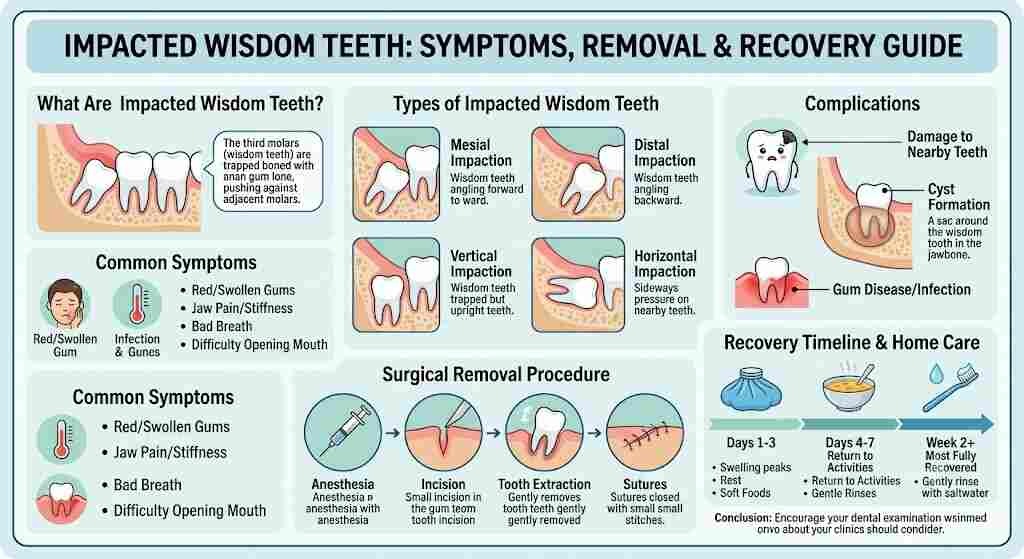
The last set of adult teeth are wisdom teeth, sometimes known as third molars. Most people have four: two on top and two on the bottom. When wisdom teeth don’t have enough room to emerge or develop normally, they become trapped within the jawbone or gums. That’s impacted wisdom teeth.
Some impacted wisdom teeth cause no symptoms at all. Others create significant oral health problems that require surgical removal. You can make better judgments regarding your dental care if you are aware of the differences.
Common Symptoms of Impacted Wisdom Teeth
Impacted wisdom teeth don’t always announce themselves. But when problems arise, your body sends clear signals. Watch for these signs:
- Gums surrounding the rear of your mouth that are red or swollen
- Tender or bleeding gums that feel sore to the touch
- Jaw pain that may radiate to your ear or head
- Swelling around the jaw area
- Bad breath or an unpleasant taste in your mouth
- Difficulty opening your mouth fully
When to See a Dentist
Schedule a dental visit if you experience any symptoms behind your last molar. Even without symptoms, regular checkups allow your dentist to monitor wisdom tooth development through X-rays.
What Causes Wisdom Teeth to Become Impacted?
The primary culprit is simple: not enough space. Human jaws have evolved to be smaller over time, yet we still develop the same number of teeth. When your jaw lacks room for third molars, they become trapped.
Additional factors include:
- Angle of eruption – teeth may grow toward adjacent teeth, toward the back of the mouth, or even sideways
- Blockages – other teeth or bone structure preventing normal emergence
- Genetics – some people naturally have smaller jaws or larger teeth
Types of Impacted Wisdom Teeth
Not all impacted wisdom teeth are the same. Dental professionals classify impaction based on positioning and depth:
| Type | Description |
| Mesial impaction | Tooth angles toward the front of the mouth (most common) |
| Distal impaction | Tooth angles toward the back of the mouth (rarest) |
| Vertical impaction | Tooth is positioned correctly but trapped beneath gums |
| Horizontal impaction | Tooth lies completely sideways, pressing against adjacent teeth |
Soft Tissue vs. Hard Tissue Impaction
- Soft tissue impaction – tooth has emerged from the jawbone but not through the gums
- Hard tissue impaction – tooth remains fully covered by both gums and jawbone
Partial vs. Full Impaction
- Partially impacted – some of the tooth crown is visible
- Fully impacted – the tooth never breaks through the gums
Complications: Why Impacted Wisdom Teeth Can Be Dangerous
Impacted wisdom teeth aren’t just uncomfortable—they can create serious oral health problems:
Damage to Other Teeth
When a wisdom tooth pushes against the second molar, it can damage that tooth or raise infection risk. This pressure also causes crowding that may require orthodontic treatment.
Cysts and Tumors
Wisdom teeth develop in sacs within the jawbone. These sacs can fill with fluid, forming cysts that damage bone, teeth, and nerves. Rarely, tumors may develop—though usually noncancerous, they still require tissue or bone removal.
Tooth Decay
Partially impacted wisdom teeth are harder to clean. Food and bacteria become trapped between the gum and tooth, dramatically increasing cavity risk.
Gum Disease (Pericoronitis)
When a wisdom tooth only partially erupts, the gum tissue around it can become painfully inflamed. This condition, called pericoronitis, causes swelling, infection, and difficulty opening your mouth.
Root Resorption
Impacted wisdom teeth can cause the roots of adjacent teeth to dissolve—a condition called external root resorption.
Do Impacted Wisdom Teeth Always Need Removal?
No. Treatment depends on your specific situation.
When Removal May Not Be Necessary
Your impacted wisdom teeth may not need removal if they are:
- Healthy
- Fully erupted
- Positioned correctly and biting properly
- Cleanable with daily oral hygiene
When Removal Is Recommended
The American Dental Association advises removal if you have:
- Pain near your wisdom teeth
- Repeated infections of the surrounding gum tissue
- Cysts or tumors
- Damage to nearby teeth
- Gum disease
- Widespread tooth decay
The Preventive Removal Debate
Some dentists recommend removing asymptomatic impacted wisdom teeth to prevent future problems. However, NHS guidelines state that pathology-free impacted wisdom teeth should not be routinely removed.
A 2020 Cochrane review found limited evidence supporting preventive removal. The decision should involve careful discussion with your dentist or oral surgeon.
The Surgical Removal Procedure
When removal is necessary, here’s what to expect:
Step-by-Step Process
- Anesthesia – local, sedation, or general anesthesia numbs the area or puts you to sleep
- Incision – the surgeon cuts through the gum tissue to expose the tooth
- Bone removal – if bone covers the tooth, the surgeon removes a small portion
- Tooth sectioning – the tooth may be cut into pieces for easier removal
- Cleaning – the wound is rinsed and cleaned
- Gum is sutured back into position using sutures.
Most procedures take 30 to 60 minutes.
Anesthesia Options
| Type | Description |
| Local anesthesia | Numbs only the surgical area; you remain awake |
| IV sedation | You’re drowsy but aware; minimal memory of the procedure |
| General anesthesia | You’re completely asleep; used for complex cases |
Recovery Timeline: What to Expect After Surgery
Most people recover from impacted wisdom teeth removal within one to two weeks.
First 24 Hours
- Rest and avoid strenuous activity
- Apply ice packs to reduce swelling
- Bite on gauze to control bleeding
- Eat soft, cool foods
- Avoid using straws (prevents dry socket)
Days 2–3
- Swelling typically peaks
- Discomfort is most noticeable
- Continue soft foods and rest
Days 4–7
- Significant improvement in pain and swelling
- Gradually return to normal activities
- Begin gentle saltwater rinses
Week 2
- Most people fully recover
- Sutures may dissolve or require removal
- Resume normal oral hygiene with care
Factors Affecting Recovery
- Age – younger patients heal faster
- Impaction severity – deeper impactions require longer recovery
- Number of teeth removed – multiple extractions extend recovery time
- Overall health – existing conditions may slow healing
Cost of Impacted Wisdom Teeth Removal
The cost varies significantly based on complexity, location, and insurance coverage:
| Procedure | Estimated Cost Range |
| Simple extraction (non-impacted) | $100–$300 per tooth |
| Partially impacted tooth | $500–$800 per tooth |
| Fully impacted (bony) tooth | $600–$1,200 per tooth |
| Horizontal impaction | $800–$1,200 per tooth |
| All four impacted teeth | $3,000–$5,000 |
Insurance typically covers 50% of medically necessary procedures, subject to annual maximums.
Home Care Tips for Faster Healing
Proper aftercare prevents complications and speeds recovery:
Do:
- Apply ice packs (20 minutes on, 20 minutes off) for the first 24 hours
- Eat soft foods like yogurt, soup, and mashed potatoes
- Keep your head elevated while resting
- Take prescribed medications as directed
- Rinse gently with warm saltwater after 24 hours
Don’t:
- Use straws (suction can dislodge blood clots)
- Smoke or use tobacco products
- Eat hard, crunchy, or spicy foods
- Exercise vigorously for at least a week
- Touch the surgical site with your tongue or fingers
Impacted Wisdom Teeth in Young Adults vs. Older Adults
Young Adults (Ages 15–22)
Removal is safer, easier, and recovery is faster. Roots aren’t fully formed, jawbone is less dense, and healing occurs more quickly.
Older Adults (Ages 30+)
Roots become longer and curved, making extraction more complex. Bone is denser, healing takes longer, and complication risks increase.
Special Considerations: Coronectomy
For impacted wisdom teeth positioned very close to the inferior alveolar nerve, a coronectomy may be recommended. This procedure removes only the crown of the tooth while leaving the roots in place, reducing nerve damage risk.
Frequently Asked Questions
Q: Can impacted wisdom teeth cause headaches?
A: Yes. Jaw pain from impacted wisdom teeth can radiate to your head, causing tension headaches or jaw aches. The pressure and inflammation around the impacted tooth often trigger referred pain that feels like a headache.
Q: How painful is impacted wisdom tooth removal?
A: You won’t feel pain during the procedure due to anesthesia. After surgery, discomfort peaks within 2–3 days and is manageable with prescribed or over-the-counter pain relievers. Most patients report the recovery is less painful than they expected.
Q: Can impacted wisdom teeth cause sinus problems?
A: Yes. Upper wisdom teeth sit close to your sinus cavity. Impacted upper molars can cause sinus pain, pressure, and congestion. Removal often resolves these sinus issues.
Q: What happens if I don’t remove impacted wisdom teeth?
A: Without treatment, impacted wisdom teeth can cause progressive damage: tooth decay, gum disease, cyst formation, damage to adjacent teeth, and in severe cases, jawbone destruction. Regular monitoring is essential if you choose not to remove them.
Q: How long does swelling last after wisdom tooth removal?
A: Swelling typically peaks around day 2–3 and begins subsiding by day 4–5. Most visible swelling resolves within one week, though minor residual swelling may persist for up to two weeks. Ice packs during the first 24 hours significantly reduce swelling.
Q: Can I resume my regular diet after having my wisdom teeth extracted?
A: Not immediately. Stick to soft, cool foods for the first few days—yogurt, applesauce, pudding, and soup. Gradually reintroduce semi-solid foods as healing progresses. Avoid hot, spicy, or crunchy foods for at least one week to prevent irritating the surgical site.
Conclusion
Impacted wisdom teeth affect millions of people—in fact, 90% of people have at least one. While some never cause problems, others lead to pain, infection, and serious dental complications. The decision to remove or monitor impacted wisdom teeth should be personalized, based on your symptoms, X-ray findings, and discussion with your dental professional.
Your next step: Schedule a dental examination if you’re experiencing any symptoms or haven’t had your wisdom teeth evaluated. Early assessment—ideally between ages 17 and 22—allows for simpler treatment and faster recovery. Don’t wait until pain forces your hand.