Mental Health Exercises: 15 Proven Techniques to Transform Your Emotional Well-Being
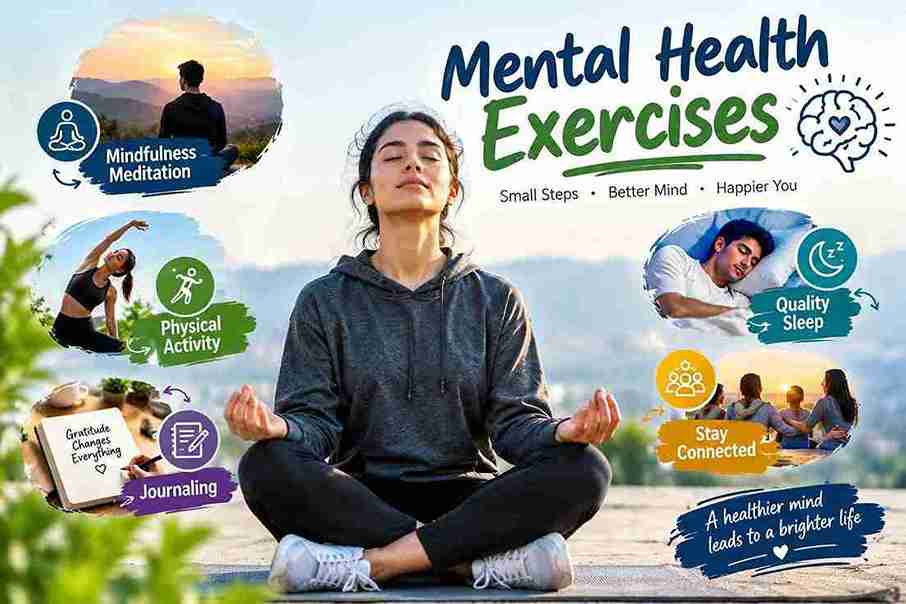
Stress and anxiety drain your energy every single day, leaving you exhausted and disconnected. When you ignore these feelings, burnout creeps in, sleep disappears, and relationships suffer. The good news? Simple mental health exercises can rewire your brain for calm, clarity, and lasting emotional strength. You do not need a therapist’s office to begin — just five minutes and the willingness to try.
What Are Exercises for Mental Health and Why Are They Important?
Mental health exercises are structured activities designed to strengthen your psychological well-being the same way physical workouts strengthen your muscles. These practices target your nervous system, thought patterns, and emotional responses to help you manage daily pressure with greater ease.
The American Psychological Association confirms that consistent self-regulation practices reduce symptoms of anxiety and depression by up to 40% over eight weeks. You build resilience through repetition, not perfection.
Think of your brain as a garden. Without attention, weeds take over. Mental health exercises pull those weeds and plant seeds of calm, focus, and emotional balance.
| Aspect | Details |
| Definition | Structured activities that improve psychological and emotional functioning |
| Primary Goal | Reduce stress, manage anxiety, and build emotional resilience |
| Time Required | 5–30 minutes per session |
| Frequency | Daily or at least 4–5 times per week |
| Who Benefits | Adults, teens, seniors, and anyone experiencing emotional strain |
| Scientific Backing | Supported by APA, NIMH, and WHO research |
[Image Prompt: A calm person sitting cross-legged on a yoga mat in a sunlit room with green plants, eyes closed, hands on knees, soft warm lighting, photorealistic style, peaceful atmosphere]
How Do Mental Health Exercises Lower Stress and Anxiety?
Your brain’s amygdala fires alarm signals when it perceives threats — even imagined ones. Chronic stress keeps this alarm stuck in the “on” position, flooding your body with cortisol and leaving you in a constant state of fight-or-flight.
Mental health exercises interrupt this cycle. Deep breathing activates your vagus nerve, which tells your brain to stand down. Mindfulness practices strengthen your prefrontal cortex, the area responsible for rational thinking and emotional regulation.
The National Institute of Mental Health (NIMH) reports that adults who practice regular stress-reduction techniques experience significantly lower cortisol levels and improved sleep quality within three weeks.
| Brain Region | What Stress Does | What Mental Health Exercises Do |
| Amygdala | Overactivates fear response | Calms threat detection |
| Prefrontal Cortex | Weakens decision-making | Strengthens rational thinking |
| Hippocampus | Shrinks under chronic stress | Supports memory and learning recovery |
| Vagus Nerve | Stays suppressed | Activates parasympathetic rest response |
Which Breathing Exercises for Mental Health Can You Do Anywhere?
Breathing exercises for mental health rank among the fastest-acting tools you can use. You carry your breath with you everywhere, which means relief is always within reach.
Box Breathing works by equalizing each phase of your breath. Inhale for four counts, hold for four, exhale for four, and hold empty for four. Navy SEALs use this technique to stay calm under extreme pressure.
4-7-8 Breathing slows your heart rate almost immediately. Inhale through your nose for four seconds, hold for seven, and exhale slowly through your mouth for eight. Dr. Andrew Weil popularized this method for insomnia and panic attacks.
Diaphragmatic Breathing engages your diaphragm instead of your chest. Place one hand on your belly and breathe deeply enough to make that hand rise. This signals your nervous system to shift from alert to relaxed.
| Exercise | Pattern | Duration | Best For | Difficulty |
| Box Breathing | 4-4-4-4 | 2–5 min | Acute stress, focus | Beginner |
| 4-7-8 Breathing | 4-7-8 | 3–5 min | Sleep, panic attacks | Beginner |
| Diaphragmatic Breathing | Deep belly inhale/exhale | 5–10 min | Chronic anxiety | Beginner |
| Alternate Nostril Breathing | Left-right alternation | 5–7 min | Balance, calm | Intermediate |
| Pursed-Lip Breathing | Inhale nose, exhale pursed lips | 2–4 min | Shortness of breath, tension | Beginner |
What Mindfulness Practices Strengthen Emotional Resilience?
Being mindful entails focusing on the here and now without passing judgment.This sounds simple, yet most people spend their waking hours replaying the past or worrying about the future.
A body scan meditation asks you to mentally sweep from your toes to your head, noticing tension without trying to fix it. This practice trains your brain to observe discomfort rather than react to it.
The five senses grounding technique pulls you back to the present instantly. Name five things you see, four you hear, three you touch, two you smell, and one you taste. This mental health exercise works especially well during panic episodes.
The World Health Organization (WHO) recognizes mindfulness-based interventions as effective complementary approaches for managing depression and anxiety disorders across all age groups.
| Mindfulness Practice | How It Works | Time Needed | Key Benefit |
| Body Scan Meditation | Systematic attention to body sensations | 10–20 min | Releases stored tension |
| Five Senses Grounding | Engages sight, sound, touch, smell, taste | 1–3 min | Stops panic spirals |
| Mindful Walking | Focus on each step and breath | 10–15 min | Combines movement with awareness |
| Loving-Kindness Meditation | Directs compassion toward self and others | 10–15 min | Reduces self-criticism |
| Mindful Eating | Full attention on taste, texture, aroma | 5–10 min | Improves relationship with food |
[Image Prompt: Close-up of hands holding a warm cup of tea near a window with rain outside, soft bokeh background, cozy and mindful atmosphere, natural lighting, editorial photography style]
How Do Cognitive Behavioral Exercises Rewire Negative Thought Patterns?
Exercises in cognitive behavioral therapy (CBT) confront the false beliefs that underlie sadness and anxiety. You develop the ability to recognize automatic negative thoughts, assess the facts, and swap them out for well-rounded alternatives.
Thought Records ask you to write down a triggering situation, the emotion you felt, the automatic thought that arose, and a more realistic reframe. Over time, this mental health activity increases self-awareness.
Behavioral Activation fights the urge to withdraw when you feel low. You schedule small, enjoyable activities — a walk, a phone call, cooking a meal — and track your mood before and after. Action precedes motivation, not the other way around.
Decatastrophizing asks one powerful question: “What is the actual worst-case scenario, and how likely is it?” Most fears shrink dramatically under honest scrutiny.
| CBT Exercise | Target Issue | How to Practice | Expected Timeline |
| Thought Records | Negative self-talk, overthinking | Write situation → thought → reframe daily | 2–4 weeks |
| Behavioral Activation | Depression, withdrawal | Schedule 1–2 pleasant activities daily | 1–3 weeks |
| Decatastrophizing | Catastrophic thinking, worry | Ask “What is the real worst case?” | Immediate relief |
| Cognitive Restructuring | Core beliefs, limiting thoughts | Identify belief → gather evidence → reframe | 4–8 weeks |
| Worry Time Scheduling | Generalized anxiety | Set 15 min daily to worry, postpone the rest | 2–4 weeks |
Can Physical Movement Serve as a Mental Health Exercise?
Absolutely. Physical movement ranks among the most powerful mental health exercises available. Exercise releases endorphins, serotonin, and brain-derived neurotrophic factor (BDNF), all of which improve mood and cognitive function.
You do not need a gym membership or an hour-long workout. A brisk 20-minute walk outdoors reduces rumination — the repetitive negative thinking linked to depression — according to research published by Stanford University.
Yoga combines movement, breath, and mindfulness into a single practice. Even gentle stretching lowers cortisol and activates your parasympathetic nervous system.
Dancing in your living room counts. The key is consistent movement that raises your heart rate and shifts your mental state.
| Movement Type | Duration | Mental Health Benefit | Accessibility |
| Brisk Walking | 20–30 min | Reduces rumination, boosts mood | High — no equipment |
| Yoga | 15–45 min | Lowers cortisol, improves flexibility | High — free videos online |
| Dancing | 10–20 min | Releases endorphins, builds joy | High — any space |
| Swimming | 20–40 min | Full-body relaxation, meditative rhythm | Medium — pool access |
| Strength Training | 20–30 min | Builds confidence, reduces anxiety | Medium — weights or bodyweight |
How Do Journaling Exercises Promote Emotional Clarity?
Journaling externalizes the chaos inside your head. When you put feelings into words, your brain processes them differently. The act of writing engages your left hemisphere, which organizes and makes sense of emotional data.
Stream-of-Consciousness Writing involves setting a timer for ten minutes and writing whatever comes to mind without editing. This mental health exercise clears mental clutter and surfaces hidden emotions.
Gratitude Journaling asks you to list three specific things you felt thankful for each day. Specificity matters — “my partner made coffee for me” hits harder than “my family.”
Letter Writing (Unsent) lets you express anger, grief, or forgiveness to someone without ever sending the words. This releases emotional weight safely.
| Journaling Method | Best Time | Duration | Primary Outcome |
| Stream-of-Consciousness | Morning or before bed | 10 min | Mental clarity, emotional release |
| Gratitude Journal | Evening | 5 min | Increased positivity, better sleep |
| Unsent Letters | When triggered | 15–20 min | Emotional closure, reduced resentment |
| Mood Tracking | Same time daily | 2 min | Pattern recognition, self-awareness |
| Prompt-Based Journaling | Anytime | 10–15 min | Guided self-reflection, insight |
[Image Prompt: Overhead flat-lay of an open journal with handwritten notes, a fountain pen, a small succulent plant, and a cup of herbal tea on a wooden desk, warm natural light, cozy aesthetic, editorial style]
What Grounding Techniques Help During Panic and Overwhelm?
Grounding techniques anchor you to the present moment when your mind spirals into panic. These mental health exercises work by engaging your physical senses and interrupting the fear loop in your brain.
The 3-3-3 Rule asks you to name three things you see, three sounds you hear, and move three parts of your body. This simple act pulls your brain out of the future and back into the room.
Temperature Shock involves holding an ice cube or splashing cold water on your face. The sudden sensory input activates your mammalian dive reflex, which slows your heart rate within seconds.
Weighted Pressure uses a heavy blanket or firm self-hug to stimulate deep pressure touch receptors. This releases oxytocin and calms your nervous system almost immediately.
| Grounding Technique | Sensory Channel | Speed of Relief | Best Situation |
| 3-3-3 Rule | Sight, sound, movement | 30–60 seconds | Public panic, meetings |
| Ice Cube Hold | Touch, temperature | 15–30 seconds | Acute panic attacks |
| Cold Water Splash | Touch, temperature | 10–20 seconds | Overwhelm, dissociation |
| Weighted Blanket | Deep pressure | 2–5 minutes | Nighttime anxiety, insomnia |
| Barefoot Grounding | Touch, proprioception | 1–3 minutes | Outdoor stress relief |
Do Gratitude Exercises Actually Shift Brain Chemistry?
Yes. Gratitude exercises increase dopamine and serotonin production in your brain. These neurotransmitters regulate mood, motivation, and sleep — the same chemicals targeted by many antidepressant medications.
A study from the University of California, Berkeley found that participants who wrote gratitude letters for three weeks showed greater neural sensitivity in the medial prefrontal cortex, a brain area associated with learning and decision-making.
Start small. Each evening, write down three moments from your day that brought you even mild pleasure. The warm sun on your face. A good cup of coffee. A text from a friend. Consistency matters more than intensity.
| Gratitude Practice | Frequency | Brain Chemistry Impact | Measurable Result |
| Three Good Things | Nightly | Boosts serotonin | Improved sleep quality |
| Gratitude Letter | Weekly | Increases dopamine | Stronger relationships |
| Mental Subtraction | Twice weekly | Enhances appreciation | Reduced hedonic adaptation |
| Gratitude Walk | 2–3x weekly | Elevates endorphins + serotonin | Lower stress markers |
| Gratitude Jar | Daily entry | Sustained dopamine release | Long-term positivity shift |
Which Sleep-Focused Mental Health Exercises Improve Rest?
Poor sleep and mental health problems feed each other in a vicious cycle. Anxiety keeps you awake, and sleep deprivation worsens anxiety the next day. Breaking this loop requires targeted mental health exercises before bed.
Progressive Muscle Relaxation (PMR) involves tensing and releasing each muscle group from your toes to your forehead. This physical release signals your brain that danger has passed and sleep is safe.
Cognitive Shuffling replaces racing thoughts with random, unrelated images. Think of a word like “BIRD” and visualize items starting with each letter — ball, igloo, river, dog. This mimics the fragmented thinking that naturally occurs as you fall asleep.
Sleep Restriction sounds counterintuitive but works. You limit time in bed to match your actual sleep hours, then gradually expand. This builds sleep pressure and consolidates rest.
| Sleep Exercise | When to Practice | Duration | Effectiveness |
| Progressive Muscle Relaxation | In bed, lights off | 10–15 min | High — reduces physical tension |
| Cognitive Shuffling | In bed, eyes closed | 5–10 min | High — interrupts rumination |
| Sleep Restriction | Nightly schedule | Ongoing | High — consolidates sleep |
| 4-7-8 Breathing | In bed | 3–5 min | Moderate — slows heart rate |
| Body Scan for Sleep | In bed | 10–20 min | High — promotes deep relaxation |
How Do Social Connection Exercises Combat Loneliness?
Loneliness carries the same health risk as smoking 15 cigarettes a day, according to the U.S. Surgeon General’s 2023 advisory. Social connection exercises rebuild the relational bonds your nervous system craves.
Active Listening Practice means putting your phone away during conversations and focusing entirely on the other person. Reflect back what you heard before responding. This deepens trust and belonging.
Random Acts of Kindness shift your focus outward. Pay for someone’s coffee. Leave a genuine compliment. Send a “thinking of you” text. These small gestures activate your brain’s reward circuitry.
Vulnerability Exercises involve sharing something real — not performative — with someone you trust. Saying “I have been struggling lately” opens doors that surface-level chatter cannot.
| Connection Exercise | Effort Level | Frequency | Emotional Payoff |
| Active Listening | Low | Every conversation | Deeper trust, reduced isolation |
| Random Acts of Kindness | Low | 2–3x weekly | Boosted mood, sense of purpose |
| Vulnerability Sharing | Medium | 1–2x weekly | Authentic connection, relief |
| Community Volunteering | Medium | Weekly | Belonging, self-worth |
| Digital Detox Dinners | Low | Weekly | Present-moment connection |
[Image Prompt: Two friends sitting on a park bench laughing together during golden hour, warm sunlight filtering through trees, candid and joyful moment, natural photography style, soft focus background]
How Do You Build a Daily Mental Health Exercise Routine?
Consistency beats intensity every time. A five-minute daily practice outperforms a one-hour session you do once a month. Start with one or two mental health exercises that fit your lifestyle and build from there.
Morning (5–10 min): Begin with box breathing or a gratitude journal entry. Set an intention for the day.
Midday (3–5 min): Use the 3-3-3 grounding technique or take a mindful walk during your lunch break.
Evening (10–15 min): Practice progressive muscle relaxation or stream-of-consciousness journaling before bed.
Track your mood on a simple 1–10 scale each week. You will notice patterns and improvements that keep you motivated. The goal is progress, not perfection.
| Time of Day | Recommended Exercise | Duration | Primary Benefit |
| Morning | Box Breathing + Gratitude Journal | 5–10 min | Sets calm tone for the day |
| Midday | 3-3-3 Grounding or Mindful Walk | 3–5 min | Resets stress, restores focus |
| Evening | PMR or Journaling | 10–15 min | Releases tension, improves sleep |
| Bedtime | 4-7-8 Breathing or Cognitive Shuffle | 5–10 min | Quiets mind, promotes rest |
| Weekend | Yoga, Nature Walk, or Social Activity | 20–45 min | Deeper restoration, connection |
Take the First Step Today
Your mental health deserves the same daily attention you give your body, your career, and your relationships. Pick one exercise from this guide — just one — and try it tonight before bed. Breathe slowly. Notice what shifts. Tomorrow, do it again.
Small actions compound into extraordinary results. You already took the hardest step by reading this far. Now put one technique into practice and watch your emotional world begin to change.
Share this guide with someone who needs it. Start a conversation. Your journey toward lasting calm begins with a single breath.