What Are the Symptoms of Lung Cancer? A Complete Guide
A cough that lingers for weeks. A tight chest after climbing the stairs. Most people blame colds, age, or stress. Lung cancer hides behind these everyday complaints, and it often stays silent until it spreads. This guide explains the symptoms of lung cancer in plain language, shows which signs need a doctor now, and gives you a clear plan for what to do next.
What Are the Symptoms of Lung Cancer?
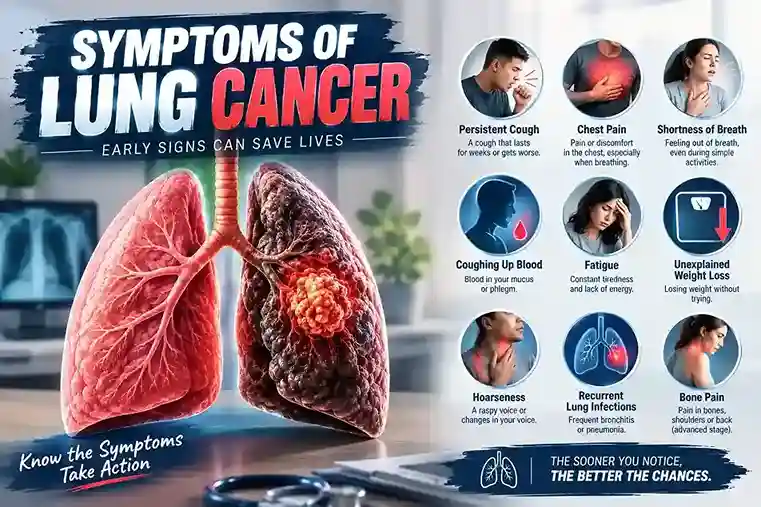
Lung cancer most frequently manifests as a persistent or worsening cough, chest pain, shortness of breath, wheezing, blood in the cough, persistent fatigue, and weight loss. with no known cause. The CDC lists these as the main warning signs. Other illnesses cause the same signs, so only a doctor can find the true cause.
Watch for these seven signs first:
- A cough that lingers or changes
- Chest pain
- Shortness of breath
- Wheezing
- Blood in your mucus
- Deep, constant fatigue
- Unexplained weight loss
Why Lung Cancer Often Stays Quiet
The lungs contain very few pain-sensing nerves. A tumor can grow for a long time without causing any discomfort. The CDC states that most people with lung cancer have no symptoms until the disease is advanced.
This silence explains why doctors urge people to act on small changes. A new breathing problem that lasts more than a few weeks deserves a checkup, even if you feel fine otherwise.
Early Lung Cancer Symptoms You Should not Ignore
Early signs are subtle, and they often look like a lingering cold. The table below describes what each one feels like and why it happens.
| # | Symptom | What it feels like | Why it happens |
| 1 | Persistent cough | A dry or wet cough that lasts over 3 weeks, or a cough that changes in sound or frequency | A tumor irritates the airway lining |
| 2 | Coughing up blood | Pink, red, or rust-colored streaks in mucus | A tumor damages small blood vessels in the airway |
| 3 | Chest pain | A dull ache or sharp pain, often worse when you breathe deeply, cough, or laugh | A tumor presses on or grows into the chest wall or lung lining |
| 4 | Shortness of breath | Feeling winded during tasks that used to feel easy | A tumor blocks an airway, or fluid collects around the lung |
| 5 | Wheezing | A new whistling sound when you breathe out | An airway narrows |
| 6 | Hoarseness | A rough or weak voice that does not recover | A tumor presses on a nerve that controls the voice box |
| 7 | Fatigue | Exhaustion that sleep does not fix | The body spends extra energy fighting disease |
| 8 | Weight and appetite loss | Losing weight without dieting, or losing interest in food | Cancer changes how the body uses energy |
| 9 | Repeat infections | Bronchitis or pneumonia that returns or does not clear | A blocked airway traps germs |
One sign alone rarely means cancer. A pattern of signs, or one sign that refuses to leave, is what matters.
Symptoms of Lung Cancer That Has Spread
Lung cancer can travel to lymph nodes, bones, the brain, and the liver. When it does, new signs appear in those areas. The American Cancer Society lists these as the main signs of spread.
| # | Symptom | What it feels like | Where the cancer has spread |
| 10 | Swollen lymph nodes | Lumps in the neck or above the collarbone | Lymph nodes |
| 11 | Bone pain | Aching in the back or hips | Bones |
| 12 | Nervous system changes | Headache, weakness or numbness in an arm or leg, dizziness, balance trouble, seizures | Brain |
| 13 | Jaundice | Yellow skin and eyes | Liver |
These signs call for prompt medical attention. They do not always mean the cancer is untreatable, and an early visit still gives you the most options.
Symptoms of Lung Cancer by Type: Small Cell vs. Non-Small Cell
Doctors divide lung cancer into two main groups. The National Cancer Institute describes both in detail.
- The most prevalent type is non-small cell lung cancer (NSCLC). Large cell carcinoma, squamous cell carcinoma, and adenocarcinoma are among them.Adenocarcinoma often starts in the outer part of the lung, so it can stay silent longer.
- Small cell lung cancer (SCLC): This type is closely tied to heavy smoking. It tends to grow and spread fast, so signs of spread may appear first.
The everyday signs, such as cough, breathlessness, and chest pain, overlap between the two types. A biopsy, not your symptoms, tells doctors which type you have.
Symptoms of Lung Cancer in Non-Smokers
Lung cancer can strike anyone, even those who have never smoked. Radon gas, secondhand smoke, asbestos, air pollution, and family history all raise the risk. The warning signs look the same as in smokers.
Because lung cancer feels unlikely, non-smokers sometimes wait longer to get checked. Do not let a clean smoking history talk you out of a visit. A cough that lasts for weeks needs an explanation no matter who you are.
Less Common Signs Worth Knowing
Some tumors cause unusual signs because of where they grow. Doctors call these syndromes.
| Sign | What you may notice | Why it happens |
| Pancoast tumor signs | Shoulder or arm pain, a drooping eyelid, a small pupil, less sweating on one side of the face | A tumor at the top of the lung presses on nearby nerves |
| Swelling of the face and arms | Puffy face, neck, upper chest, or arms, with trouble breathing | A tumor presses on a large vein (superior vena cava syndrome) |
| Trouble swallowing | Food feels stuck or swallowing hurts | A tumor presses on the esophagus |
| High calcium levels | Extreme thirst, constipation, nausea, confusion | Some tumors release substances that raise blood calcium |
If you notice any of these, contact a doctor quickly.
Symptoms or Something Else? How to Tell the Difference
Most coughs and breathing problems come from common, treatable conditions. Many illnesses mimic the symptoms of lung cancer, which makes self-diagnosis unreliable. This table shows typical patterns.
| Condition | Typical pattern | Clue that points away from cancer |
| Common cold | Cough, runny nose, sore throat | Fades within 1 to 3 weeks |
| Bronchitis | Cough with mucus after a cold | Improves within a few weeks |
| Pneumonia | Fever, chills, sharp chest pain | Responds to treatment |
| Asthma or COPD | Long-term wheeze and breathlessness | A known diagnosis with a steady pattern |
| Acid reflux | Dry cough with heartburn | Worse after meals or at night |
| Lung cancer | Lasting or changing cough, blood in mucus, weight loss, infections that keep returning | No clear cause, and no improvement |
A change in a long-standing condition also counts. If your usual COPD cough suddenly sounds different, tell your doctor.
When to See a Doctor
Book a visit if you notice symptoms of lung cancer that last more than three weeks. Do not wait for several signs to pile up.
See a doctor soon if you have
- A cough that lasts over three weeks or changes in character
- Hoarseness that does not clear
- Unexplained weight loss
- Pneumonia or bronchitis that keeps coming back
- Blood in your mucus, even a small streak
Call emergency services if you have
- Large amounts of coughed-up blood
- Severe trouble breathing
- Sudden, severe chest pain
Before your appointment, write down when each sign began and whether it is changing. Tell your doctor about your smoking history, radon or asbestos exposure, and any family history of lung cancer.
How Doctors Diagnose Lung Cancer
When symptoms of lung cancer prompt a visit, doctors work through a series of tests. Each step narrows down the cause.
| Test | What it shows |
| Chest X-ray | Spots or masses in the lung |
| CT scan | A detailed 3D view of the lungs and nearby lymph nodes |
| Sputum test | Cancer cells in coughed-up mucus |
| Bronchoscopy | A direct camera view of the airways, with tissue samples |
| Biopsy | The only way to confirm cancer and identify its type |
| PET, MRI, or bone scan | Whether cancer has spread |
| Biomarker testing | Gene changes that guide treatment choices |
Lung Cancer Screening: Who Should Get Checked Before Symptoms Start
Screening looks for cancer in people who feel healthy. The test is a low-dose CT scan. The American Cancer Society notes that yearly screening for people at high risk can save lives.
US guidelines focus on adults roughly 50 to 80 years old with a heavy smoking history. Rules differ by country and change over time, so ask your doctor whether you qualify.
Screening does not replace a diagnosis. If you already have symptoms of lung cancer, ask for diagnostic testing instead of waiting for a screening slot.
Risk Factors Linked to Lung Cancer
| Risk factor | Why it matters |
| Smoking | The leading cause; risk rises with years and amount smoked |
| Secondhand smoke | Breathing others’ smoke raises risk for non-smokers |
| Radon gas | A natural gas that seeps into homes from soil |
| Asbestos and workplace chemicals | Fibers and fumes damage lung tissue over time |
| Family history | A close relative with lung cancer raises your risk |
| Prior chest radiation | Earlier treatment to the chest can raise risk |
| Air pollution | Long exposure to polluted air adds risk |
How to Lower Your Risk and Catch Problems Early
Knowing the symptoms of lung cancer helps, but you can also act before any sign appears.
- Quit tobacco. Quitting at any age lowers your risk. Ask your doctor or a local quitline for support.
- Test your home for radon. Low-cost kits are widely available.
- Avoid secondhand smoke. Ask smokers to step outside.
- Wear protective gear at work. Follow safety rules around dust, fumes, and asbestos.
- Ask about screening. Bring up your age and smoking history at your next checkup.
Your Next Step
Lung cancer rarely announces itself, but your body often leaves clues. Learn the symptoms of lung cancer, track any cough or breathing change that lasts beyond three weeks, and book a visit instead of waiting. If you smoke or used to, ask about screening and quitting support. Share this guide with someone who coughs “just from a cold” and encourage them to get checked. One appointment can change the outcome.