Pediatric Dental Sealants: The Complete Parent’s Guide to Cavity Prevention for Kids
Introduction
Your child’s permanent molars erupt with deep grooves that toothbrush bristles simply cannot reach. Food particles and bacteria settle into these tiny crevices, and cavities begin forming before you even notice. Pediatric dental sealants offer a simple, painless solution that stops this process cold.
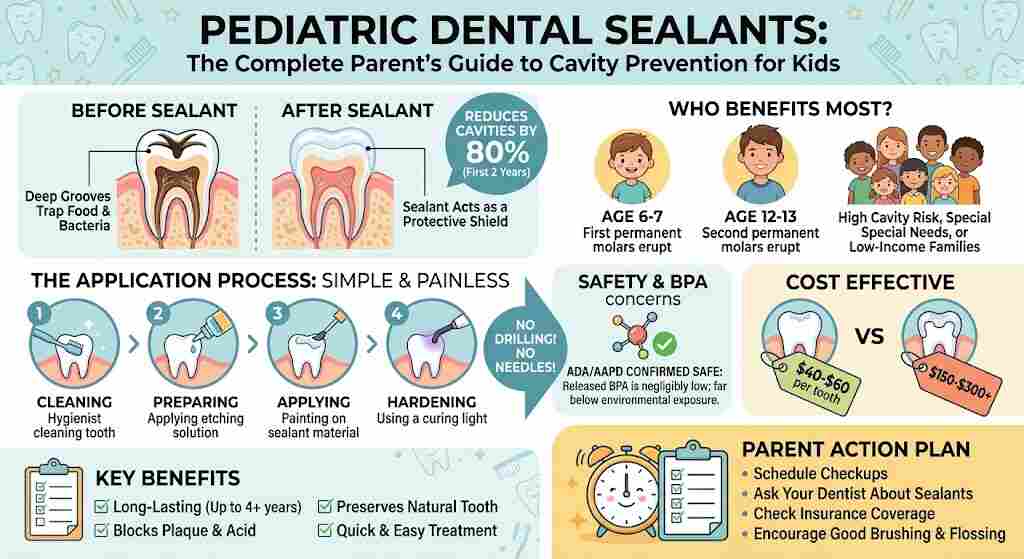
Research shows sealants reduce cavities by 80% during the first two years after placement. This guide walks you through everything parents need to know about pediatric dental sealants—from how they work to what they cost and why experts strongly recommend them.
What Are Pediatric Dental Sealants?
Pediatric dental sealants are thin, protective plastic coatings applied to the chewing surfaces of back teeth. Dentists paint these coatings onto the deep grooves and pits of molars and premolars. Once applied, the sealant hardens into a smooth shield that blocks out food, plaque, and bacteria.
Think of pediatric dental sealants like raincoats for teeth. The sealant covers the vulnerable areas where cavities most often start, creating a barrier that prevents decay from taking hold. The American Dental Association (ADA) and the American Academy of Pediatric Dentistry (AAPD) both strongly recommend sealants for children and adolescents.
Pediatric dental sealants differ from fillings. Fillings treat existing decay. Sealants prevent decay from happening in the first place. This distinction matters because prevention costs less, causes less discomfort, and preserves more natural tooth structure.
How Do Dental Sealants Work to Prevent Cavities?
The chewing surfaces of molars contain deep pits and grooves. These natural fissures trap food particles and harbor bacteria. Even diligent brushing cannot clean these microscopic crevices because toothbrush bristles are too large to enter them.
Pediatric dental sealants fill these grooves completely. The liquid sealant flows into every pit and fissure, then hardens to create a smooth, flat surface. With the grooves sealed, bacteria cannot settle in, acids cannot erode enamel, and cavities cannot form.
The mechanism is straightforward: sealants provide a physical barrier. They do not kill bacteria or release medications. They simply block the conditions that allow decay to develop. This protective effect works immediately upon application and continues for years.
Research confirms the effectiveness of pediatric dental sealants. A Cochrane systematic review found that resin-based sealants reduce tooth decay in children by 11% to 51% more than no sealant when measured two years after application. The Community Preventive Services Task Force strongly recommends school-based sealant delivery programs based on strong evidence of effectiveness.
Types of Pediatric Dental Sealants: Which Is Best?
Several types of pediatric dental sealants exist, and each has distinct characteristics.Resin-Based Sealants set through a polymerization reaction, usually triggered by a dental curing light. These sealants offer superior retention—meaning they stay in place longer than other types. Studies show resin-based sealants achieve retention rates of 90% at six months and 66.7% at 18 months.
Complete retention of resin-based sealants varies between 53% and 90% at 12-month follow-up, exceeding 80% at 24 months. Dentists consider resin-based sealants the gold standard.Glass Ionomer Sealants set through an acid-base reaction. They release fluoride, which can help strengthen surrounding tooth enamel. They also tolerate moisture better during application. However, glass ionomer sealants have lower retention rates—only 6.1% at six months in some studies. Their caries-preventive efficacy remains comparable to resin-based materials despite poorer retention.Resin-Modified Glass Ionomers and Polyacid-Modified Resins combine features of both categories.
Setting through a mixture of acid-base and polymerization reactions.Bioactive Sealants represent newer options with retention rates around 85%. They perform particularly well in high-risk patients.
Which type should you choose? The ADA/AAPD clinical practice guideline could not determine superiority of one sealant type over another. The panel recommended that any evaluated material—resin-based, resin-modified glass ionomer, glass ionomer cement, or polyacid-modified resin—can be used.
Material choice depends on clinical conditions like moisture control and the child’s cooperation level. Your child’s dentist will select the most appropriate option for your specific situation.
Who Should Get Pediatric Dental Sealants?
Pediatric dental sealants benefit most children, but certain groups need them most urgently.Children at high risk for cavities gain the greatest advantage. A 2025 systematic review confirmed that resin-based sealants are still recommended for high-caries-risk children.
High-risk children have a greater risk of developing new carious lesions than low- or moderate-risk children, making sealants especially valuable for them. In contrast, the effect of sealants was negligible in low-caries-risk children when comparing sealed and nonsealed teeth.
Children aged 6 to 11 years represent the primary target group. School sealant programs typically focus on this age range, corresponding to grades 1 through 5. The first permanent molars erupt around age 6, and the second permanent molars appear around age 12. Applying pediatric dental sealants soon after these teeth erupt provides maximum protection.
Children from low-income families face higher cavity rates and less access to dental care. Compared with children from higher-income families, low-income children are more likely to have untreated cavities, fewer sealants, and fewer yearly dental visits. School-based programs specifically target schools with higher percentages of children eligible for free or reduced-cost meals.
Children with special needs also benefit from sealants. The AAPD includes individuals with special needs in their care management pathways.
The Pediatric Dental Sealant Application Process
The application process for pediatric dental sealants is quick, simple, and painless. Here is what happens step by step:
Clean the tooth. The dentist or hygienist cleans the chewing surface thoroughly to remove plaque and debris.
Dry and isolate the tooth. The surface is dried completely. Cotton rolls or other isolation materials keep the area dry.
Apply etching solution. A mild acid solution—similar in strength to vinegar or lemon juice—is applied to the tooth surface for about 15 to 30 seconds. This roughens the enamel slightly so the sealant bonds properly.
Rinse and dry. After rinsing off the etching solution, the tooth is once more dried.
Apply the sealant. The liquid sealant is painted onto the grooves of the tooth.
Harden the sealant. A curing light hardens the sealant in about a minute. Some sealant types harden through chemical reaction without a light.
The entire process takes only a few minutes per tooth. No drilling, no numbing, and no discomfort.
One important note: pediatric dental sealants work best when applied to teeth that are cavity-free. If the tooth already has decay, the dentist may need to treat the cavity before applying sealants or may recommend an alternative approach.
Do Pediatric Dental Sealants Hurt?
Pediatric dental sealants do not hurt. The application process involves no drilling, no needles, and no removal of tooth structure.Children may feel slight pressure during cleaning or mild tingling from the etching solution, but these sensations are brief and mild. Most children tolerate the procedure easily without any anesthesia.
Parents often worry about their child’s anxiety. The good news: the procedure is so quick and straightforward that even young children typically cooperate well. Dentists who work with children use child-friendly language and techniques to make the experience positive.A 24-month randomized controlled trial evaluated both hydrophilic and hydrophobic resin-based sealants in uncooperative children and found that both types performed similarly. This suggests that even children who have difficulty sitting still can benefit from sealants.
How Long Do Pediatric Dental Sealants Last?
Pediatric dental sealants provide protection for many years, but they do require monitoring and occasional replacement.The Cochrane Collaborative found that resin-based sealants effectively prevent tooth decay in children for up to 4 years. Research also shows that sealants protect against 80% of cavities during the first two years after placement.
Long-term retention varies. At one-year follow-up, 90% of resin-based sealants remained completely retained. At 18 months, complete retention ranged from 57.1% to 76.4% depending on materials and techniques used. At three years, retention ranged from 41% to 87%. After 10 years, only about 35% of teeth retained sealants, but resealing increased retention significantly.
Sealants can wear down or come off over time. Regular dental checkups allow the dentist to check sealant integrity. If a sealant is missing or worn, the dentist can replace it easily. Resealing significantly reduces dental decay over 10 years at reasonable costs. Replacing lost sealants improves dental health outcomes by reducing both cavities and filling costs.
Are Pediatric Dental Sealants Safe?
Yes, pediatric dental sealants are safe. Major health organizations—including the ADA, AAPD, CDC, and the Community Preventive Services Task Force—endorse their use.BPA concerns are addressed. Some parents worry about Bisphenol A (BPA) exposure from dental sealants.
The ADA has thoroughly investigated this concern. The average sealant releases only 0.09 nanograms of BPA. For comparison, the Environmental Protection Agency has proposed a limit of 1 million nanograms of BPA per day for a 6-year-old child. Dental sealants fall far below this threshold.
The ADA further notes that children are exposed to more BPA from food, drinks, air, and thermal paper than from dental sealants. None of the sealant materials with the ADA Seal of Acceptance produce detectable levels of BPA. The ADA states there is no evidence that BPA exposure from dental sealants has any adverse health effects.
Allergic reactions are rare. Sealant materials are well-tolerated. The ADA/AAPD guideline panel found no significant adverse events associated with sealant use.
The benefits far outweigh any risks. Pediatric dental sealants prevent cavities, which avoids the need for fillings, extractions, and more invasive procedures. The safety profile of sealants is excellent, and their public health impact is substantial.
School-Based Sealant Programs: Free Access for Kids
School-based sealant programs bring pediatric dental sealants directly to children at school, removing barriers like cost, transportation, and parental work schedules.
How these programs work. Licensed dental professionals visit schools with portable equipment. They screen children for oral disease, check if children already have sealants, and apply sealants to those with parental permission. The sealants are typically provided at no cost. Any child needing follow-up care receives a referral to a local dentist.
Why do these programs matter? School sealant programs are especially important for reaching children at greater risk for developing cavities and less likely to receive private dental care. By applying sealants to the nearly 7 million children in lower-income households who do not have sealants, we could prevent more than 3 million cavities and save up to $300 million in dental treatment costs.
Cost-effectiveness. School sealant programs can be cost-saving within 2 years of placing sealants. Delivering sealants to high-risk children can be cost-saving for Medicaid. These programs represent one of the most effective public health interventions available.
Federal support. The federal government promotes sealant use by classifying pediatric dental services as an essential health benefit, matching state costs for sealant application for Medicaid and CHIP enrollees, encouraging community health centers to expand sealant programs, and funding state efforts to increase sealant programs.
Pediatric Dental Sealants Cost and Insurance Coverage
The cost of pediatric dental sealants varies, but they remain highly affordable compared to treating cavities.Typical costs. Without insurance, sealants typically cost $30 to $60 per tooth. Many dental offices offer discounts for multiple teeth or for children from the same family.
Insurance coverage. Most dental insurance plans cover pediatric dental sealants for children. Medicaid and CHIP cover sealants for enrolled children as part of EPSDT preventive dental benefits, generally with no copay.
Private dental insurance often covers sealant placement, though some plans have exclusions or limitations.School-based programs offer free sealants. The most affordable option is school-based sealant programs, which provide sealants at no cost to families.
Cost comparison. Consider this: a single filling can cost $150 to $400 or more, depending on the tooth and the extent of decay. Sealants cost a fraction of this amount and prevent the need for fillings entirely. When you factor in the time, discomfort, and potential for more extensive treatment, sealants are clearly cost-effective. Studies confirm that sealants are cost-effective when compared with the costs of averted restorations.
Dental Sealants vs. Fluoride Varnish: What’s the Difference?
Parents often ask whether sealants or fluoride varnish provides better protection. Both are valuable, but they work differently.Fluoride varnish strengthens tooth enamel and helps reverse early decay. It is applied to all tooth surfaces and works systemically by making enamel more resistant to acid attacks.
Fluoride varnish does not fill in grooves or provide a physical barrier.Pediatric dental sealants fill the deep grooves of molars and provide a physical barrier that blocks food and bacteria. Sealants only protect the chewing surfaces where they are applied.The guideline recommendation. The ADA/AAPD guideline panel recommends prioritizing sealants over fluoride varnish on permanent molars with sound occlusal surfaces or noncavitated carious lesions.
Both offer benefits, but sealants provide more targeted protection for the highest-risk surfaces.The best approach. Most children benefit from both fluoride and sealants. Fluoride protects all tooth surfaces, while sealants protect the vulnerable grooves that fluoride cannot reach. Together, they provide comprehensive cavity prevention.
Frequently Asked Questions About Pediatric Dental Sealants
Q: At what age should my child get dental sealants?
A: The ideal time is soon after the permanent molars erupt. First permanent molars typically appear around age 6. Second permanent molars emerge around age 12. School sealant programs typically focus on children aged 6 to 11 years. Your child’s dentist will evaluate when each tooth is fully erupted and ready for sealant application.
Q: Can adults get dental sealants too?
A: Yes. Sealants can benefit adults who have deep grooves in their molars and no existing decay or fillings on those surfaces. However, children and adolescents benefit most because their newly erupted teeth have not yet developed cavities.
Q: Do sealants cover all teeth or just molars?
A: Sealants are typically applied only to the chewing surfaces of back teeth—molars and premolars. These teeth have the deepest pits and grooves and face the highest cavity risk. Front teeth have smoother surfaces that do not require sealants.
Q: What happens if a sealant falls off?
A: If a sealant falls off, the tooth loses its protection and becomes vulnerable to cavities again. The dentist can replace the sealant easily during a regular checkup. Replacing lost sealants improves dental health outcomes by reducing both cavities and filling costs.
Q: Are sealants covered by dental insurance?
A: Most dental insurance plans cover sealants for children. Medicaid and CHIP cover sealants for enrolled children as part of preventive dental benefits, typically with no copay. Coverage details vary by plan, so check with your insurance provider.
Q: Can sealants be placed over existing cavities?
A: Dentists can place sealants over very early, noncavitated lesions to arrest their progression. The ADA/AAPD guideline panel recommends sealants for permanent molars with noncavitated occlusal caries lesions. However, if the decay has progressed to a cavity, the dentist will need to treat it before or instead of applying a sealant.
Conclusion
Pediatric dental sealants represent one of the most effective, safest, and most cost-effective ways to protect your child’s teeth from cavities. The evidence is clear: sealants reduce cavities by 80% in the first two years, last for years, and cost far less than treating the decay they prevent.
Major health organizations—the CDC, ADA, AAPD, and the Community Preventive Services Task Force—all strongly recommend them.The application process is quick, painless, and simple. No drilling. No needles. No discomfort. Just a few minutes per tooth and years of protection. School-based programs bring free sealants directly to children who need them most.Here is your action plan:
Ask your child’s dentist about sealants at your next visit. If your child’s permanent molars have erupted, schedule the application. If cost is a concern, ask about school-based programs or check your insurance coverage. Do not wait until cavities form—prevention is always better than treatment.Your child deserves a lifetime of healthy smiles. Pediatric dental sealants help make that possible. Talk to your dentist today and give your child the protection they need.