Wisdom Teeth Removal: Your Complete Guide to a Smooth Recovery
That dull ache at the back of your jaw. The swelling that makes chewing uncomfortable. The dentist’s recommendation you’ve been putting off. Wisdom teeth removal is one of the most common dental procedures performed today, yet most people have no idea what actually happens during the process.
If you’re facing this procedure, you need clear answers. What does wisdom teeth removal involve? How long does recovery take? Is it really necessary? This guide walks you through everything—from understanding why these molars cause problems to what you can expect during each stage of healing.
Why Do We Have Wisdom Teeth? What Are They? {#what-are-wisdom-teeth}
Wisdom teeth—also called third molars—are the last set of teeth to emerge at the very back of your mouth. Most adults have four wisdom teeth, one in each corner of the upper and lower jaws.
They typically appear between ages 17 and 25, a life stage once called the “wisdom years.”Thousands of years ago, our ancestors needed these extra molars. Their diets consisted of raw plants, tough meats, and coarse foods that required serious grinding power. But human jaws have evolved.
Over time, cooking softened our food, and our jaws grew smaller. Today, many people simply don’t have enough room for these latecomers.When there’s no space, wisdom teeth become impacted—meaning they’re stuck beneath the gum or only partially emerge. This is where problems begin.
Do You Really Need Wisdom Teeth Removal? {#do-you-need-removal}
Not everyone needs wisdom teeth removal. The American Association of Oral and Maxillofacial Surgeons (AAOMS) has moved away from blanket extraction recommendations. Instead, they endorse individualized assessments that weigh clinical findings, X-ray evidence, and your personal risk factors.
When you might safely keep your wisdom teeth (according to AAOMS and ADA guidelines):
- Completely erupted and non-impacted
- Fully functional for chewing
- Painless and free of decay
- Free of gum disease
- Capable of being properly cleaned with routine brushing and flossing
The American Dental Association (ADA) recommends that people between 16 and 19 visit their dentist for a wisdom tooth evaluation. Why this age range? Roots are less developed, and complications are fewer when wisdom teeth removal happens earlier.
Signs Your Wisdom Teeth Need to Come Out {#signs-you-need-removal}
According to the ADA, wisdom teeth removal may be necessary when you experience:
- Pain or swelling in the back of your mouth
- Infection around the gum tissue (pericoronitis)
- Crowding or misalignment of other teeth
- Decay in the wisdom tooth or the tooth in front of it
- Cysts or tumors forming around the impacted tooth
- Damage to adjacent teeth or bone
“Leaving wisdom teeth in elevates your risk of cavities and gum disease,” explains Dr. Janowicz from Cleveland Clinic. That’s why extraction is sometimes recommended as a precaution.
The National Institute for Health and Care Excellence (NICE) guidelines help surgeons decide when the benefits of wisdom teeth removal outweigh the risks of keeping them.
The Wisdom Teeth Removal Procedure Step by Step {#the-procedure}
Wisdom teeth removal typically takes 30 to 60 minutes. Here’s what happens during the procedure:
Pre-Surgery Evaluation
Your dentist or oral surgeon takes X-rays to determine the position of your wisdom teeth and whether removal is necessary. You’ll discuss anesthesia options to ensure your comfort during the procedure.
Administering Anesthesia
Depending on the complexity of your wisdom teeth removal, your surgeon uses local anesthesia (numbing just the area), sedation, or general anesthesia. If you receive sedation or general anesthesia, arrange for someone to drive you home.
The Extraction
- For erupted wisdom teeth (fully visible): The dentist loosens the tooth and removes it with forceps.
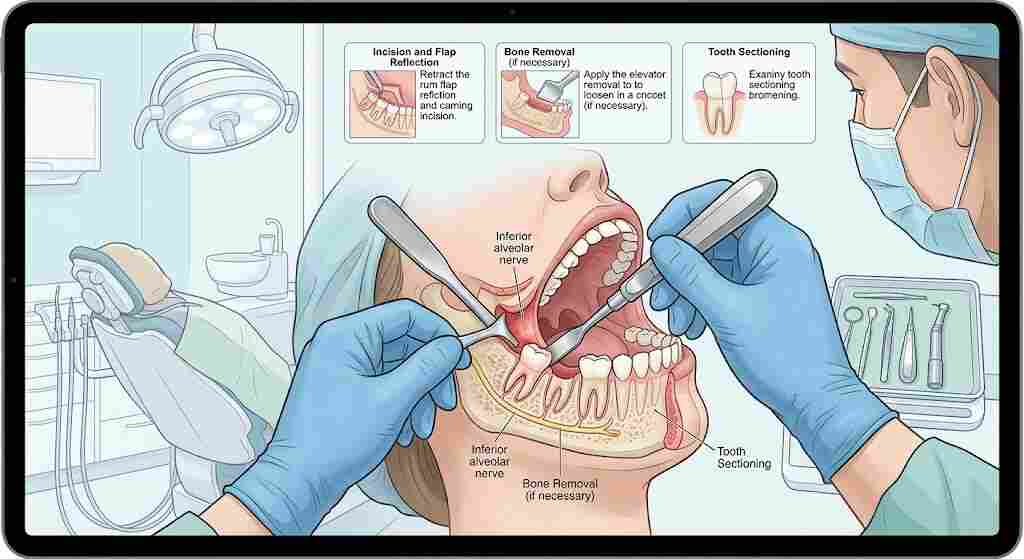
- For impacted wisdom teeth (stuck beneath the gum): The surgeon makes a small incision in the gum. Sometimes bone around the tooth is removed with a drill, and the tooth may be cut into smaller pieces for easier removal.
The area is cleaned, and stitches are placed. Usually, these sutures come out on their own in one to two weeks. Gauze is packed over the site for about 30 minutes to control bleeding.
Types of Anesthesia for Wisdom Teeth Removal {#anesthesia-options}
Your oral surgeon will recommend one of three anesthesia options based on the complexity of your wisdom teeth removal:
| Type | What It Does | Best For |
| Local Anesthesia | Numbs the specific area with an injection in the gum | Simple extractions of fully erupted teeth |
| Sedation Anesthesia | Relaxes you while keeping you awake | Patients with anxiety or moderately complex cases |
| General Anesthesia | Puts you completely to sleep | Difficult extractions, multiple teeth, or high anxiety |
Wisdom Teeth Removal Recovery Timeline {#recovery-timeline}
Healing after wisdom teeth removal is a process that unfolds over several weeks. Here’s what to expect:
First 24 Hours
- Bleeding is normal. Bite down on gauze with firm pressure—bleeding should stop within 2 hours.
- A blood clot forms in the socket where the wisdom tooth was removed.
- Rest is critical. Take it easy for at least 24 hours.
- You may feel dizzy or extra tired from the anesthesia.
Days 2 to 3
- Swelling typically peaks on the second or third day.
- Continue resting with your head elevated while sleeping.
- You may experience jaw stiffness (trismus), which is temporary and expected.
Days 4 to 7
- Most people return to work or school.
- Swelling gradually improves.
- Pain should decrease significantly.
Week 1 to 2
- The surgical site begins regenerating new tissue to close the wound.
- Most patients resume their regular diet and routine.
- Full healing of the mouth typically takes 1 to 2 weeks.
Weeks 3 to 4
- Repair tissue fills the socket completely.
- New bone tissue begins growing to fill the socket.
- Healing continues over several months.
Wisdom Teeth Removal Aftercare: What to Do {#aftercare-what-to-do}
Following your surgeon’s instructions is the single most important factor in a smooth recovery. Here’s what helps:
Control Bleeding
- Bite down firmly on gauze over the extraction site.
- Replace gauze as needed. Some oozing for a few days is normal.
Manage Pain and Swelling
- Take pain relievers as prescribed or recommended (ibuprofen and paracetamol work well).
- Apply an ice pack to the outside of your cheek for 10 minutes at a time, with 5-minute breaks.
- After 72 hours, moist heat can help if your jaw remains sore.
Rest and Recover
- Rest is essential in the first few days.
- Avoid strenuous activities, exercise, and sports that could interfere with healing.
Eat and Drink Wisely
- Start with soft foods: oatmeal, bananas, mashed potatoes, smoothies, yogurt, soups, and eggs.
- Drink plenty of water.
- Once bleeding stops, try thin smoothies, milkshakes, protein drinks, or milk.
- Slowly reintroduce solid foods as you feel comfortable.
Keep the Area Clean
- Resume brushing your teeth the day after surgery, but avoid the surgical sites.
- Gently rinse with warm salt water (half teaspoon of salt in a glass of warm water) several times a day.
- Your surgeon may prescribe a special mouthwash.
- If provided, use a plastic irrigating syringe to flush food debris from extraction sites as directed.
Follow Up
- Attend all scheduled follow-up appointments.
- These visits allow your surgeon to monitor healing and address concerns.
Wisdom Teeth Removal Aftercare: What to Avoid {#aftercare-what-to-avoid}
Equally important—here’s what NOT to do after wisdom teeth removal:
Do Not Disturb the Blood Clot
The blood clot that forms in the socket protects the bone and nerves beneath. If it dislodges, you risk developing a painful dry socket.
Avoid these things that can dislodge the clot:
- For the first several days, avoid giving your mouth a strong rinse.
- Do not drink through a straw—suction can pull out the clot.
- Do not spit forcefully. Instead, drool into a tissue.
- Do not brush directly over the surgical sites.
Avoid Irritating Foods and Drinks
- Do not drink hot liquids—heat may increase swelling or bleeding.
- Do not drink carbonated beverages like sodas or sparkling water.
- Do not eat crunchy, chewy, or sticky foods for at least 2 weeks.
- Avoid acidic foods (oranges, tomatoes) and spicy foods.
- Avoid alcohol—it interferes with wound healing and can make pain medications less effective.
Do Not Smoke
- Do not smoke or use tobacco for at least a week.
- Smoking significantly slows healing and increases complication risks.
Do Not Drive on Pain Medication
- Do not drive while taking prescription pain medicine.
Potential Risks and Complications {#risks-and-complications}
Wisdom teeth removal is a safe and common operation. However, as with any surgery, complications can occur. Making an informed choice is made easier when you are aware of these hazards.
Common Post-Operative Issues
- Swelling, pain, and bleeding – These are normal and expected.
- Jaw soreness and bruising – Common for about the first week.
Less Common but Serious Complications
- Dry socket – The blood clot dislodges, exposing bone and nerves. This is one of the most common complications, particularly in older patients or those undergoing complex extractions.
- Infection – Signs include fever, worsening pain, swelling, or a bad taste in your mouth.
- Nerve injury – Can cause temporary or permanent loss of sensation, taste changes, or tingling in the lip, tongue, or chin. The prevalence rate of lingual nerve injury after surgical removal of mandibular third molars is approximately 5.58%.
- Sinus problems – Upper wisdom teeth are close to the sinuses; removal can occasionally create a communication between the mouth and sinus.
- Jaw fracture – If bone has been removed, the jaw may be more susceptible to fracture.
- Hemorrhage – Excessive bleeding can occur in rare cases.
Reducing Your Risk
- Choose an experienced oral and maxillofacial surgeon (OMS).
- Follow all pre- and post-operative instructions carefully.
- Be honest about your medical history, medications, and habits like smoking.
- Remove wisdom teeth before age 20 when roots are less developed and risks are lower.
How Much Does Wisdom Teeth Removal Cost? {#cost-of-removal}
The cost of wisdom teeth removal varies widely based on complexity, location, and insurance coverage.
Typical Cost Ranges
- Simple extraction (fully erupted tooth): $149 to $300 per tooth
- Partially impacted wisdom tooth: $500 to $800 each
- Horizontally impacted wisdom tooth: $800 to $1,200 each
- Four wisdom teeth removal (all surgical): $2,000 to $5,000 total
Without insurance, costs can reach up to $2,000. Check with your dental insurance provider about coverage. Many plans cover a portion of wisdom teeth removal when medically necessary.
When to Call Your Surgeon {#when-to-call-your-surgeon}
Contact your oral surgeon immediately if you experience:
- Severe or persistent pain that doesn’t improve with medication
- Excessive bleeding that won’t stop with pressure
- Fever or signs of infection
- Swelling that worsens instead of improving
- Numbness that persists beyond a few days
- Difficulty breathing or swallowing (rare but serious)
Frequently Asked Questions {#faq}
How painful is wisdom teeth removal?
During the procedure, anesthesia ensures you feel no sharp pain—only pressure or movement sensations. Afterward, mild to moderate discomfort is expected as the anesthesia wears off. Over-the-counter or prescription pain medications effectively manage this discomfort. Most people find the pain manageable and significantly improved within 3 to 7 days.
How long does it take to recover from wisdom teeth removal?
Most people return to work or school within 3 to 5 days. Full healing of the mouth takes 1 to 2 weeks. However, the bone beneath continues healing for several months. Your age, the complexity of your wisdom teeth removal, and how well you follow aftercare instructions all affect your recovery speed.
Can I eat after wisdom teeth removal?
Yes, but start with liquids and soft foods. Once bleeding stops, try thin smoothies, protein drinks, or milk. Move to soft solids like oatmeal, mashed potatoes, yogurt, and soups. Avoid hot, spicy, crunchy, or chewy foods. Slowly reintroduce solid foods as you feel comfortable.
What is a dry socket and how can I prevent it?
A dry socket occurs when the blood clot protecting the extraction site becomes dislodged or dissolves, exposing bone and nerves. This causes significant pain. To prevent dry socket: avoid using straws, don’t spit forcefully, don’t smoke, and don’t rinse vigorously for the first few days. If you develop a dry socket, your surgeon can place a medicated dressing to relieve pain.
After having my wisdom teeth out, when can I wash my teeth?
You can resume brushing the day after surgery—but avoid the surgical sites directly. Brush gently and carefully. After about a week, you can gently rinse with warm salt water (half teaspoon salt in a glass of warm water) several times a day. Your surgeon may also prescribe a special mouthwash.
Is wisdom teeth removal covered by insurance?
Most dental insurance plans cover at least a portion of wisdom teeth removal when medically necessary. Coverage varies by plan. Some medical insurance may also cover part of the procedure if it’s deemed medically necessary. Check with your provider before scheduling wisdom teeth removal to understand your out-of-pocket costs.
Final Thoughts {#final-thoughts}
Wisdom teeth removal is one of the most common dental procedures—approximately five million Americans undergo it each year. While the thought of oral surgery can feel intimidating, knowing what to expect transforms anxiety into confidence.
The key to a smooth experience comes down to three things: choosing an experienced oral surgeon, following pre-operative instructions, and committing to proper aftercare. Your surgeon’s guidance isn’t optional—it’s the difference between a quick recovery and unnecessary complications.
Ready to take the next step? Schedule a consultation with an oral and maxillofacial surgeon to evaluate your wisdom teeth. Early evaluation—ideally between ages 16 and 19—means less developed roots, fewer complications, and a faster recovery.Your future self will thank you for addressing this now rather than waiting for pain, infection, or damage to nearby teeth.